Showing posts with label Anisospondyl. Show all posts

Wednesday, 22 July 2026

Cladistics: Parasymmetrodactylae

Modern Anisospondyls can be placed into one of three major categories. There are the Brachiostomata, a group which was apparently very diverse in Eryobis' her past but is now only represented by a handful of species. There are the Trapezostomata, the Anisospondyls that evolved an enlarged bone below their jaws that effectively acts as a table to keep food from falling out of their mouths.
And then there are the Cryptognatha, the Anisospondyls that evolved a second set of jaws derived from their palate- and tongue bones and the group that by far the most modern Anispondyls fall into. 

Cryptognaths as a clade are quite old and fossils like those from the Frouren Formation show that they were already around by the middle of the Bobossic period 145 million years ago. Curiously enough, this actually makes Cryptognaths the youngest clade among the surviving Anisospondyls, as Trapezostomes are estimated to have evolved over 12 million years before the first Cryptognaths appeared.
Yet despite-, or perhaps because of their later appearance on the world's stage, Cryptognaths are the most successful, numerous and diverse terrestrial vertebrates Eryobis has ever seen. One major reason for this is the fact that genetic evidence points to at least 4 different lineages of Cryptognaths surviving through the devastating cataclysm known as the World Scarring, making them the effective inheritors of Eryobis.

When biologists first touched down on Eryobis, they classified the Cryptognath Anisospondyls in 2 major groups: The Paleodactylae and the Symmetrodactylae. As the name may infer, this distinction was made based on the anatomy of their feet. Specifically, the amount of digits on the front limbs. 
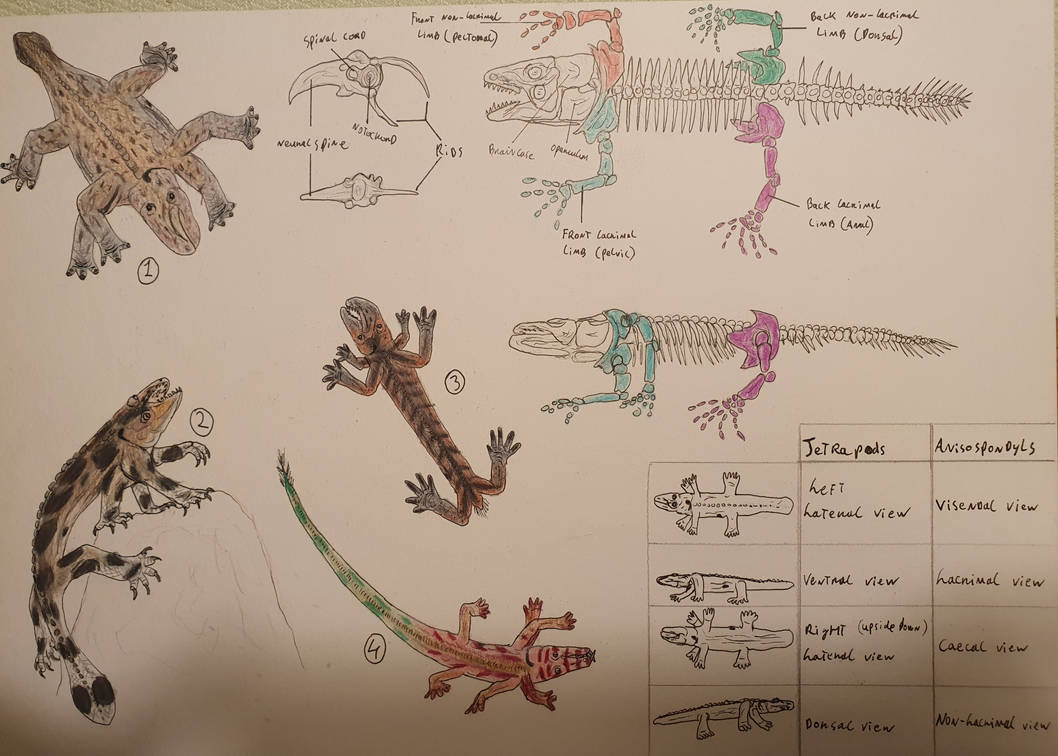
Due to the strange evolutionary history and anatomy of Anisospondyls, the left and right (neural and lacrimal) front limbs are not homologous as one side will have been derived from the pectoral fins while the other came from the pelvic fins. Because of this and perhaps some ancient bottleneck early on in their evolution, Anisospondyls evolved with 3 digits on their neural (pectoral) limbs and 4 digits on their lacrimal (pelvic) limbs. This asymmetry has seemingly been the ancestral condition for pretty much every Anisospondyl group since their conception.
Cryptognaths are no exception. Biologists quickly noticed that that certain Cryptognaths had asymmetrical toes and this, combined with the knowledge that this asymmetry is a primitive trait, led to these Cryptognaths being labeled as "Paleodactyls". While this term has partially held up, its counter part, the term "Symmetrodactyls", has not.
Symmetrodactyls were grouped based on the fact that the toes on the lacrimal and neural limbs were equal in number and thus symmetrical.


That however, is where the relationship between "Symmetrodactyls" ended. Genetic testing and studies of their embryonic development revealed that the so called "Symmetrodactyls" were actually 3 distinct, largely unrelated clades. These were subsequently named: Eusymmetrodactylae, Parasymmetrodactylae and Effingodactylae.


Although the digits of Eusymmetrodactyls and Parasymmetrodactyls may look superficially similar, having a standard number of three digits on all front limbs, the differences in structure between the two groups already starts shortly after conception. Where Eusymmetrodactyls lost the fourth digit on their lacrimal limbs, the Parasymmetrodactyls lost their first digit to achieve digit symmetry. So while leaving similarly looking footprints, genetic testing found that Parasymmetrodactyls are actually more closely related to the Effingodactyls than to the Eusymmetrodactyls.

Yet, their relation to Effingodactyls is not a close one, having split well before the World Scarring event occurred. As such, Parasymmetrodactyls are a very diverse clade.
There are a number of physical traits that nearly all Parasymmetrodactyls share such as a scale covered hide, ectothermy and an olfactory organ located above the visendal mouth corner. This organ is often accompanied by a bony growth or spike and likely evolved from a taste organ that migrated outside the mouth to act as a nostril, as the Parasymmetrodactyls lost their true, fish-like ancestral nostrils.
The most basal members of Parasymmetrodactylae are the Siludrilidae, a family of serpentine Anisospondyls native solely to Hatèmica. Not much is known about these creatures as they all appear to be either fossorial, aqautic or a combination of both. From the specimens we have recorded and studied, we've found out that Siludrilids have very small, almost rudimentary eyes and instead rely on a pair of barbels on their mandibles to sense their surroundings. 

Genetic evidense suggests that Siludrilids are the sister group to all other living Parasymmetrodactyls, which are classified as the Xenosauropsia. This group in turn seems to be into two major branches which likely diverged in the Recrescian stage of the Anaktisian period around 100 million years ago.

First of these branches is known as the Novocordea. What marks this group is the anatomy of their hearts and the fact that they do not seem to be completely ectothermic, with one family, the fully aquatic Sirenosauridae, being in fact homeothermic animals. These often marine animals are mostly herbivores that stay close to coastlines around Eryobis that will feed on seaweeds, though many supplement their diet with invertebrates and some are fully durophagous with a diet consisting largely of pectinauts. 

Vyarisauria
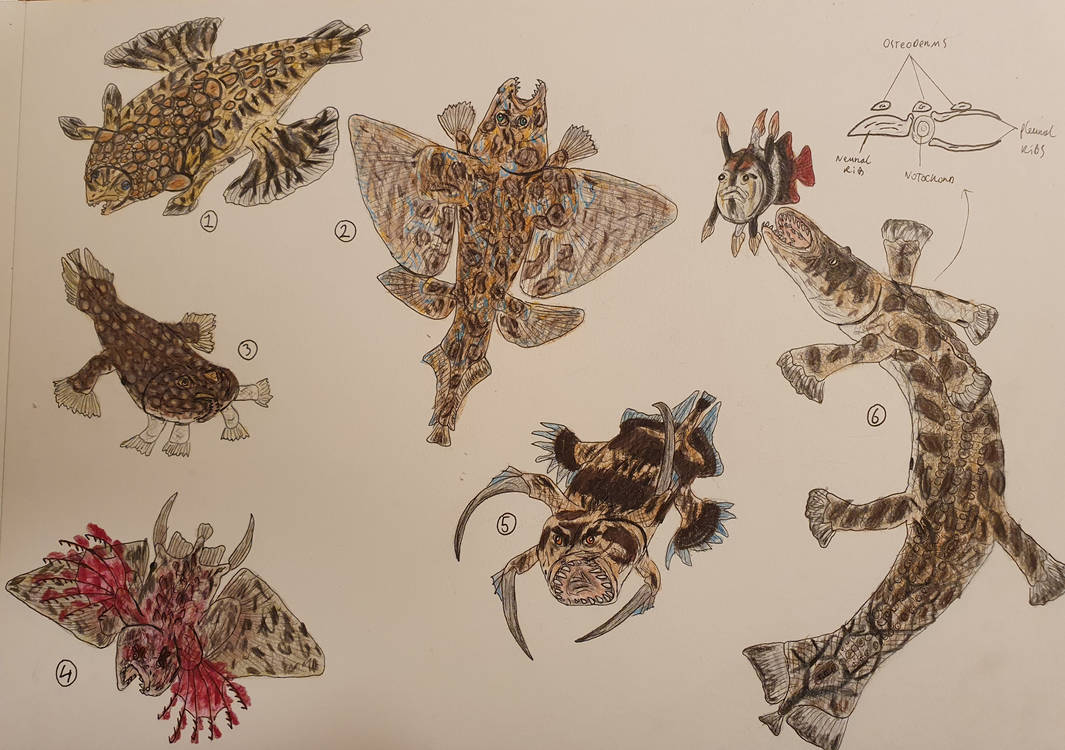
Like the Sirenosaurids, many other Novocordeans seem to be aquatically inclined. The Vyarisauria are a clade consisting of several families of Xenosauropsians that are hypothesised to have originated on the shores of the Vyaris Ocean when it was forming as the paleocontinent Kwispuul broke apart. The least aquatic Vyarisaurs are the members of the Tarandrosauridae. The species in this family are often iguana like animals and are often omnivorous or herbivorous. The most striking characteristic of this family is that most males grow large horn- and antler like structures from their mandibles. These structures can actively impede their ability to feed, so it is likely that females use them to judge the fitness of males. In addition, some species have been recorded using these stuctures for both intraspecific combat and defense.

The great majority of crocodilian resembling Anisospondyls belong to the aptly named family Eryosuchidae. Much like terran crocodiles, these Vyarisaurs are often semiaquatic, armour plated carnivores. Eryosuchids can be found in tropical and subtropical regions all around the world where they prey on a wide variety of animals ranging from small fish to large game. While all Eryosuchids can swim, the degree to which they do this can vary quite a lot per species and region, as some Erysuchids will spend almost their entire lives living on land.

Another family of semiaquatic Vyarisaurs isthe Phocasauridae. These creatures can also be found all around the world, but unlike Eryosuchids have an elevated metabolism and higher body temperate that allows them to venture into temperate water as well. Much like the animals they derive their name from, the pinnipeds of old Earth, Phocasaurs can often be seen resting, alone or in colonies, on beaches and rocky outcrops in the sea. Phocasaurs can be extremely large animals, with the largest species reaching over 8 meters in length, though their long and muscular tail does take up half that length. As such, the diets of Phocasaurs can also differ quite a bit per species. Some are small fish specialists, sporting rows of jagged interlocking teeth that form a cage no fish can escape from. Others are large prey specialists, feeding on other marine Anisospondyls like aquatic Stauropterygians and Chalacheiropterans or even other Phocasaurs and then others are durophages or specialise in soft bodied invertebrates.


Cynerpetoidea
Curiously, despite being the most aquatic of the Novocordeans, the Sirenosaurids are not that closely related to the Vyarisaurs. Instead these marine grazers appear to be at or near the base of a superfamily known as the Cynerpetoidea. Unlike their closest living relatives, all members of this superfamily are mostly terrestrial. While bearing a vague resemblance to ancient land crocodilians of Earth, the Cynerpetoids are not Eryosuchids, with the similarities in appearance, most notably the rows of osteoderms and large scales  likely being the result of convergent evolution.
The smallest and most widespread Cynerpetoids are the members of the family Suchocyonidae. These animals tend to be on the smaller side compared to some of their relatives, usually not exceeding 50 kilograms in weight. They are more omnivorous and often live in burrows. While they likely originated in Bloëcan Miesjeta like the other members of their superfamily, the Suchocyonids somehow crossed the Vyaris Ocean around 10 million years ago, likely rafting from Azchèda to Hatèmica and Lachoba. How they did this remains somewhat of a mystery, though one theory is that Suchocyonids have a higher salt tolerance than Cynerpetoids.

The Cynerpetidae on other hand, have always remained in Miesjeta. Among their relatives, it is the Cynerpetids with the highest metabolisms, which is perhaps why they of their relatives are most common in the older regions of the continent such as Azchèda and Lotharca. These creatures are fast animals that often hunt by chasing their prey down over a short distance. They also appear to among the most intelligent Xenosauropids besides Phocasaurs and Sirenosaurs and it is Cynerpetids that have been domesticated by the Eryobian natives in some regions.

The Cipehyolidae family contains some of the largest land carnivores alive on Eryobis. These carnivores are often the apex predators in the regions where they live, with especially the tropical and subtropical forest and wetland regions of Bloëca falling under their domain. Some biologists have compared Cipehyolids to ancient terran carnivores like Rauisuchians and Sebecids for these creatures also resemble land crocodiles. The biggest Cipehyolids of tropical Bloëca have been rumoured to stand up to 2 meters tall at the hip and measure over 10 meters from head to tail, which would indeed make them among the largest land predators of Eryobis and also some of the biggest terrestrial carnivores Humanity has ever encountered.


Eucryocardia
The second large branch of the Xenosauropsia is the one leading up to the Eucryocardia. As the name might suggest, all members of this clade are entirely ectothermic, which recent studies have shown might actually be a derived trait rather than the ancestral condition. The majority of modern Parasymmetrodactyls are Eucryocardians, with a majority of the latter belonging to the Eryolacertilia. Despite having been determinded to be the sister group to all other Eucryocardians and thus being the most basal, Eryolacertilians can be found on every continent except Rubiëra and fill most of the niches we'd associate with lizards on Earth and other colonies. They are a very diverse group and most are quite small, with only a handful surpassing 1 meter in length.


Plicataventria
Some of the strangest animals on Eryobis, which is saying something, are members of the group called Plicataventria. 
At the base of this group are two families of aberrant creatues that vaguely remind of tortoises. The Irrisiidae, a family native soley to Hatèmica, are the most basal Plicataventrioids. They are odd creatures. They walk quadrupedally, but not in a way comparable to any other Anisospondyl. They walk soley on both pairs of their front limbs, with their hindlimbs being very small and located at the rear of their bodies. Because of this, they have extremely large pectoro-pelvic girdles that connect their front limbs, which makes their bodies rather stiff. This type of locomotion and stiff body morphology can be seen across all members of Plicataventria. Irrisiids have small osteoderms on their backs and are mostly omnivores. It has been reported that they use their small hindlimbs in the digging process as well as with mating.

A slighly more derived family of Plicataventroids are the Opistonychidae. Native to deserts all across Miesjeta, these creatures invoke the sense of "tortoise" more than perhaps any other Anisospondyl. They possess an anatomy that is very similar to that of the Irrisiids, though Opistonychids sport large plate like osteoderms on their back and evolved their hind limbs for a different purpose than digging. Rather Opistonychids have elongated the claws on their hindlimbs and turned them into defensive spikes. Akin to terran porcupines, Opistonychids will turn their spiky rears towards potential threats for defense and as they retain control over individual claws, they can quite accurately stab their aggressors if necessary.

The higher Plicataventria can be divided into four groups. 
Most basal of these is the family known as Plicatachelidae. These animals are almost exclusively aquatic and can only be found in the Rukard Sea, the inland sea that lies on the border between southern Miesjeta and Azchèda, and the rivers and lakes that are connected to it. Plicatachelids are mostly herbivores or feed on invertebrates. Though their bodies and osteoderms are covered by a thick layer of leathery skin, their skeletons reveal that their bodies are folded. The arms below the mouths of Plicatachelids are in fact their hind limbs.
It is currently thought that Plicatachelids were pushed into the aquatic niches they hold in modern times from another, closely related group that began spreading around Bloëca around the same time the former appear in the fossil record, the Corythostegoidea. This superfamily clearly displays the folded body that Plicataventrians are known for. With rows of hard keratin covered bony plates running all along their backs, the well armoured creatures tend to be herbivores and omnivores and are often quite small. 

Across the Vyaris Ocean in Lachoba and Guralta is where two other families of Plicataventrians can be found. Most notable of these are the Apelathedontidae, a family of carnivores that are among the largest terrestrial Plicataventrians. In a curious case of convergent evolution, Apelathedonts have evolved large bony projections from their mandibles akin to Tarandrosaurids. They use them for completely different purposes however, as Apelathedonts seem to have evolved these structures to help them tackle large prey. In addition, these carnivores have have and blade like claws on their hind limbs, which are located below the mouth, to help them tear into live prey and carcass alike.
The Entomosauridae are the other Plicataventrian family that can be found in the western hemisphere, with members from Lachoba all the way to southern Tlèëa. Much like their cousins, Entomosaurids are a bit more carnivorous than their Miesjetan counterparts, though the majoirity of Entomosaurids are also quite small creatures that can very often be found scurrying in the undergrowth.


Saurrhamphia
Besides the peculiar Plicataventria, there is another major branch of Eucryocardians that can be found on Eryobis, the Saurrhamphia. As much be indicated by the naming, the members of this clade all have some form of beak or keratinous structure at the tips of their mandibles. Because of this, some researchers have proposed that the ancestral members of this clade were quite specialised herbivores that would later radiate into a wider range diets.
A good supporter for this ancestral herbivory theory comes in the form of the Asaurocnidae, which have been shown to be basal to all other Saurrhamphians. This is a family of slow moving arboreal herbivores that can often be found hanging upside down from tree branches much like sloths of old Earth, except these creatures are truly ectothermic. With strong limbs and very large curved claws, Asaurocnids are experts at not moving much.
Another family of arboreal Saurrhamphians are the Salitostiliidae, whose members are best characterised by their large hind limbs that allow them to jump between the canopy. Salitostiliids often have beaks that strongly curve downwards. It is believed that this allows them to break into tree bark to access arthropods living beneath, though they also include leaves and "fruits" into their diet.
Some of the most charismatic creatures on Eryobis are members of the Microdrakonidae, which as their name would imply, can indeed look like little dragons. These somewhat skink like creatures are quite common across Guralta and Tlèëa where they mainly feed on plant matter such tubers and also feed on various kinds of arthropods. Microdrakonids are often covered in extensive bony plates, osteoderm stubs and spikes, which makes them quite well protected from a large portion of the potential predators they share their habitats with.

The Eryobiguanidae were for a long considered to be members of Eryolacertilia before DNA testing showed them to be Saurrhamphians. It is easy to see the mistake, as Eryobiguanids retain many basal Xenosauropsian traits that are commonly associated with Eryolacertilians, such as a rather lizard like body shape. Eryobiguanids, much like the terran iguanas they share their name with, Eryobiguanids are mostly herbivores, though a few omnivorous and carnivorous species also exist.

Some of the strangest faces of any Anisospondyls belong to the members of the Arpazognathidae. These Saurrhampians represent the third time a group of Xenosauropsians evolved to look and behave like iguanas since the World Scarring and all evolved on a different continent in a glaring way of convergent evolution, with the Tarandrosaurs in Guralta, Lachoba and Tlèëa, the Eryobiguanids in Miesjeta and the Arpazognathids in Hatèmica. 
Much like their ecological counterparts, Arpazognathids are mostly herivores with a few exceptions. Curiously similarly to the unrelated Tarandrosaurs, Arpazognathids also display sexual dimorphism with males growing large bony structures on their heads. These often include spikes growing from the beak on the mandibles, which are often accompanied by a large arching horn that grows from between the eyes. Male Arpazognathids have often been seen duelling with other males in a way strangely reminiscent of certain beetles from Earth.

At some point though, a mutation occured in some Arpazoganthoids that made females also grow such structures. It would not have taken long for this mutation to become accompanied by an increasingly carnivorous diet as they began to use this additional weaponry to hunt other animals. It would be from such mutated populations that the Ginguridae would evolve. They would take the use of their bony growths to new extremes as they developed a unique jaw mechanism that allows them to move their mandibles up and down in addition to opening them side to side as is typical for Anisospondyls. Because of the mechanism, which bears some similiarity to that which was seen in Haidomyrmecinae ants of Cretaceous Earth, Gingurids can slam their prey against the "roof" of their jaws which evolved from the horn that grew from between their eyes. Gingurids are a relatively new family that have seen great success and quickly spread around Eryobis, filling the niche of semiaquatic ambush predators like crocodiles. The fossil record and even modern reports show that whenever Gingurids occur in the same region as Eryosuchids, the Gingurids tend to dominate and even can even replace them completely in an ecosystem.


When one observes the distribution of Parasymmetrodactyls across Eryobis, it becomes clear that they are a very "western" group, as none of their ancestrally terrestrial members can be found in Rubiëra in the east.
This points to Parasymmetrodactyls having evolved in the ancient supercontinent of Kwispuul and rather than spreading across oceans, merely drifted to new locations as tectonics pulled Kwispuul apart, with a few exceptions where some must've rafted over. Additionally, the Parasymmetrodactyls seem to be more aquatically inclined than any other kind of Anisospondyl, with a number of families independently evolving to live mostly in the water. Their specialisation in ectothermy and energy conservation allows them to fill completely different niches to Eusymmetrodactyls and Effingodactyls, which gives them an evolutionary edge like no other.
Currently they exist all over the world except in the coldest of regions and are likely to continue to do so for many millions of years to come. 

The most reptilian looking and behaving of all Anisospondyls, many Parasymmetrodactyls are quite popular as pets for both natives and humans alike 
 

Friday, 2 January 2026

Cladistics: Effingodactylae

Modern Anisospondyls can be placed into one of three major categories. There are the Brachiostomata, a group which was apparently very diverse in Eryobis' her past but is now only represented by a handful of species. There are the Trapezostomata, the Anisospondyls that evolved an enlarged bone below their jaws that effectively acts as a table to keep food from falling out of their mouths.
And then there are the Cryptognatha, the Anisospondyls that evolved a second set of jaws derived from their palate- and tongue bones and the group that by far the most modern Anispondyls fall into. 

Cryptognaths as a clade are quite old and fossils like those from the Frouren Formation shows that they were already around by the middle of the Bobossic period 145 million years ago. Curiously enough, this actually makes Cryptognaths the youngest clade among the surviving Anisospondyls, as Trapezostomes are estimated to have evolved over 12 million years before the first Cryptognaths appeared.
Yet despite-, or perhaps because of their later appearance on the world's stage, Cryptognaths are the most successful, numerous and diverse terrestrial vertebrates Eryobis has ever seen. One major reason for this is the fact that genetic evidence points to at least 4 different lineages of Cryptognaths surviving through the devastating cataclysm known as the World Scarring, making them the effective inheritors of Eryobis.

When biologists first touched down on Eryobis, they classified the Cryptognath Anisospondyls in 2 major groups: The Paleodactylae and the Symmetrodactylae. As the name may infer, this distinction was made based on the anatomy of their feet. Specifically, the amount of digits on the front limbs. 
Due to the strange evolutionary history and anatomy of Anisospondyls, the left and right (neural and lacrimal) front limbs are not homologous as one side will have been derived from the pectoral fins while the other came from the pelvic fins. Because of this and perhaps some ancient bottleneck early on in their evolution, Anisospondyls evolved with 3 digits on their neural (pectoral) limbs and 4 digits on their lacrimal (pelvic) limbs. This asymmetry has seemingly been the ancestral condition for pretty much every Anisospondyl group since their conception.
Cryptognaths are no exception. Biologists quickly noticed that that certain Cryptognaths had asymmetrical toes and this, combined with the knowledge that this asymmetry is a primitive trait, led to these Cryptognaths being labeled as "Paleodactyls". While this term has partially held up despite it becoming clear that "Paleodactyls" are almost definitely polyphyletic , its counter part, the term "Symmetrodactyls", most certainly has not held up.
Symmetrodactyls were grouped based on the fact that the toes on the lacrimal and neural limbs were equal in number and thus symmetrical.


That however, is where the relationship between "Symmetrodactyls" ended. Genetic testing and studies of their embryonic development revealed that the so called "Symmetrodactyls" were actually 3 distinct, largely unrelated clades. These were subsequently named: Eusymmetrodactylae, Parasymmetrodactylae and Effingodactylae.
While the digits of Eusymmetrodactyls and Parasymmetrodactyls look superficially very similar, being three toed on all front limbs, the Effingodactyls are clearly different, possessing four toes on all front limbs. Other Anisospondyl groups have achieved front-limb-digit-symmetry by reducing digits like the other "Symmetrodactyl" Cryptognaths did or by fusing digits as Brachiostomes and Liomedactyl Trapezostomes have done. 
Effingodactyls are different. 
Instead, Effingodactyls appear to have grown a new digit on their neural front limbs. Studies on the embryonic development of their front limbs have shown that this extra digit is the result of a "domesticated" form of polydactyly whereby the third digit of the neural limbs duplicates to form a new "fourth" digit. While birth defects like this usually tend to get weeded out over time, it is theorized that this particular case of polydactyly was so advantageous to early Effingodactyls that it gave those with it an evolutionary edge over those without, ensuring that the condition became anchored in the gene pool. 

Genetic evidence and the molecular clock point to modern Effingodactyls having appeared and differentiated between 110 and 90 million years ago, during the Recrescian stage of the Anaktisian period. Fragmentary fossils from this period in time suggests that these early Effingodactyls were small and often arboreal creatures. Yet, the most basal members of the group that still live to this day are neither. The Perucatheriidae is a family of a handful of species of quite primitive Effingodactyls native exclusively to the tropical island of Boncorm, west of Miesjeta. Rather odd looking creatures, most agree that Perucatheriids were already present in Borncorm before it became an island, where it became a refuge for them while their kin died out elsewhere as time went on. They are easily recognizable by their often extravagant and vividly coloured crests made of fleshy and inflatable tissue. These structures grow from the visendal spiracle and are much more developed in males than in females.

Another family of very basal Effingodactyls is the Gnathoglossidae. Similarly to the Perucatheriids, Gnathoglossids appear to be relics left alive only because of isolation. The island continent of Hatèmica has been largely isolated for an estimated 70 to 50 million years, which makes it a last stronghold for many lifeforms that have gone extinct elsewhere, so it should be little surprise that it is here where Gnathoglossids can be found. These creatures bear some resemblance to echidnas and anteaters from Earth and in similar fashion, Gnathoglossids have been recorded feeding predominantly on eusocial, often colony building, arthropods. These creatures permanently keep their visendal front limbs off the ground. This is likely done to protect the large claws of these limbs from becoming dull. They use these claws for intraspecific combat, defense and most importantly for breaking into colonies and tree bark to access their food. The "tongue" that Gnathoglossids possess is in actuality an extremely long and extendable pharynx, for at the end of the tongue there is a tiny set of jaws, which are of course the linguo-palatal jaws that Cryptognaths are known for. How exactly Gnathoglossids feed has yet to be properly studied, but most agree that they use their pharynx akin to how an anteater would use its tongue, sticking it into a hole where it would lap up arthropods with adhesive saliva before retreating it back into the mouth. It is likely that Gnathoglossids filter their prey from their pharynx with insides of their lips so they can be lined up for the small mouth to swallow.
In addition to large claws, Gnathoglossids are also quite well armored, possessing multiple rows of large osteoderms all over their body which, combined with their sometimes surprisingly large sizes, makes them formidable foes for anything that dares to tackle them.

With the exception of the two aforementioned families, almost all other living Effingodactyls fall into the supergroup called Gharibotheria. The members of this group are typically seen as the most mammal-like of all Eryobian creatures. They are all endothermic, viviparous, are covered in filament that can best be described as fur and possess pinnae on their shoulder-ears made of flesh, cartilage and muscle, much like those of mammals. At the very base of Gharibotheria, or perhaps even outside it, are the Archaeojanoridae. A family of generally small and shrew like creatures, Archaeojanorids differ from all other Gharibotheres in the anatomy of their inner ears, underdeveloped ear pinnae, lower metabolism, sprawling hind limbs and the fact that they seem to be ovoviviparous, still developing eggs but hatching them while still inside the body. 
They can be found all over Guralta, with a handful of species also being found in Lachoba and Tlèëa. They are typically nocturnal and mostly feed on small invertebrates. Some species of Archaeojanorids possess long caniniform teeth lined with deep grooves, leading some biologists to suspect they might be venomous. No studies have been conducted to confirm this however.


Similarly to how it is the last refuge of the Gnathoglossids, the island continent of Hatèmica is home to another basal family of Gharibotheres called the Glossolatiriidae. These odd Gharibotheres have long been the subject of debate among biologists. A combination of primitive and derived traits has made their placement on the Effingodactyl phylogenetic tree rather difficult, though most seem to agree that they form their own branch and aren't particularly related to any other current Gharibotheres. 
Glossolatiriids tend to be omnivores that fill niches we would associate with raccoons, opossums and mustelids on Earth, being opportunistic and highly adaptable to their environments. They can be found in almost every habitat in Hatèmica and some species can even be found on the continent of Lachoba, likely been brought there after heavy storms dragged them out to sea where they would have clung to rafts of driftwood.


Thylacophora
The other Gharibotheres can be placed into one of two major branches. Arguably the most diverse of these branches leads to the Thylacophora, the "pouch bearers". As their name might suggest, these Gharibotheres possess a pouch made of skin and muscle, very much like those of the marsupials from Earth. The likeness to mammals is even more strengthened by the fact that Thylacophorans possess what are essentially mammary glands within their pouches.
An interesting anatomical trait that sets Thylacophorans apart almost all other living Anisospondyls is the shape and configuration of their pectoro-pelvic girdles, which are angled "in reverse", as this placement puts their visendal front limbs anterior to their caecal front limbs. While there are a couple of other groups that also have this trait, such as Machairoplatid and Pseudokadrid Trapezostomes as well as the extinct Syrinchotids, the vast majority of Anisospondyls possess the reverse girdle arrangement; with the caecal front limbs anterior to the visendal front limbs. A side effect of this arrangement is that it caused their external ears to migrate to a position in front of the limbs, instead of between them as is typically the case in Cryptognaths, which likely happened to avoid the pinnae getting in the way of the moving limbs, or vice versa. Because this makes it seem as if the ears sprout from the back of the head, this adaptation contributes even more to the Thylacophorans' likeness to mammals.
Some of the most basal Thylacophorans are the Phascolictoidea, a superfamily of generally small, omnivorous creatures that can be found all over Miesjeta. Many explorers call them rabbits, possums or roos for their superficial similarity to these Earth animals.

In a curious case of evolution having no regard for our laws of convention, the family of the largest Thylacophorans is most closely related to some of the smallest. The Brachiorhinidae are large herbivores that bear a striking resemblance to elephants. Their fleshy spiracular nose has developed into a prehensile trunk and they often possess large ears to dissipate heat, although this last trait is something seen in a number of unrelated large Gharibotheres. While Brachiorhinids may not have tusks, they do keep their visendal front limbs permanently off the ground. These limbs are tipped by large claws are most often used for digging, scratching bark off trees, pulling branches down to feed and for combat. They typically weigh in between 400 kilograms and 5 tons, yet they still carry their young in a pouch. These pouches face backwards and the young tend to leave these pouches while still being quite small so as to not put too much strain on the mother.
The closest relatives of the Brachiorhinids are the Atsidatheroidea, which also have backwards facing pouches. These creatures are typically rodent like in appearance and often fill the niches of small, nocturnal herbivores. Many of them are also fossorial, which would explain why their pouches face backwards, as this prevents dirt from getting in the pouch. It is as of yet unknown how Atsidatheroids avoid competition with Triprotodont Trapezostomes, as both of these groups associated with rodent like niches.

Despite not being particularly related to the previous two groups, another family that shares the backwards facing pouches is the Telomechrhinidae. This is a family of badger or hog like, typically omnivorous, nocturnal creatures native to Tlèëa and northern Guralta. In a curious case of convergent evolution, these creatures evolved an elongated bone above their jaws, something only seen in the extinct Ceratanodirids. The similarity is only superficial however, as the purpose of these bony growths is for completely different between these unrelated groups. In Ceratanodirids it served for combat, in Telomechrhinids it forms a support for the nose, which is extended all the way to the front of the jaws. While this gives Telomechrhinids a superior olfactory sense, it also prevents them from using their jaws to an extent, as they cannot properly hold food as other Anisospondyls can. For this reason, many Telomechrhinids have larger teeth on the caecal side of their jaws than on the visendal side.

Aiodyparxii
Genetic testing has revealed that Telomechrhinids are most closely related to the largest group within the Thylacophora: the Aiodyparxii.
The members of this group can be highly divergent in morphology and lifestyle, but there are a couple of characteristics that almost all share. A majority of their members are at least partially arboreal and it is likely that this has always been the case because it seems that an ancestral trait is the digits on their front limbs being heterodactyl, meaning that the inner two digits are opposable to the outer two. This actually disregards the actual embryonic number of the toes, as it means that the visendal front limbs will have their 1st and 2nd digits opposable while on the caecal limbs it will be the 3rd and 4th digits.
Another ancestral trait that they all have is a specialized and highly complex vocal organ that allows them to make sounds that can match those of Earths songbirds in acoustic complexity. 
Considered by many biologists to be the most basal Aiodyparxians are the Trogailurids, a family of vaguely cat or quoll like, often arboreal carnivores that live in Lachoba and southern Guralta. These creatures are most often solitary, but like the cats of Earth, are also often held as pets by native populations.
It is assumed that it was from Trogailurid like creatures that the most diverse Aiodyparxians of all, and actually Effingodactyls as a whole, evolved: the Chalacheiroptera. When Eryobian explorers are asked about the "birds of this world", chances are they are thinking of a Chalacheiropteran. These flying creatures are some of the most widespread animals on Eryobis, existing from pole to pole and every landscape in between. Many explorers call them "sharos", a likely nod to the fact that many of them fly with their hindlimbs like the Triassic reptile from Earth called Sharovipteryx. Their limb configuration is indeed quite odd, as many of them walk bipedally on their caecal front limbs, while their hind limbs have been turned into large wings for powered flight and with their visendal front limbs being smaller wings used mainly for steering.
While this is the case for the vast majority of Chalacheiropterans, there are a small number of basal members that instead have it reversed; flying mostly with their visendal front limbs while the hindlimbs are used to steer. Curiously, the Chalacheiropterans with this configuration also tend to have heavily reduced caecal front limbs, as the way the muscles of these creatures work apparently cannot empower one without drawing from the other. This phenomenon has also been observed with the other flying Anisospondyls, the Stauropterygia, where instead of just one pair, both pairs of front limbs were turned into wings for powered flight, which apparently is possible with Anisospondyl anatomy. The Chalacheiropterans that fly with their front limbs are often terrible at walking on the ground due to their caecal limbs being reduced and the others being wings.

Another major group within the Aiodyparxii is the Thylacopithecoidea. As their name might suggest, these creatures bear a great resemblance to primates, being very intelligent, often arboreal animals with forward facing eyes. Quite unlike primates however, these creatures tend to have large, movable ears and sport claws on their digits. Almost all members of this group live in tropical and subtropical regions around Miesjeta, most in notably rain- and monsoon forests. There are of course exceptions to this, with certain species living in the savannas or high in the mountains while others live in some colder climates. But the most notable exceptions are a number of members of the Sammelkidae family. While Sammelkids are often the most arboreal of all Thylacopithecoids, with some members never voluntarily touching the ground, this family also contains the most terrestrial of them all. Due to the strange anatomy of Sammelkids, the terrestrial species have evolved to walk bipedally on their visendal front limbs while permanently holding their caecal- and hind limbs off the ground. It is these strange terrestrial Sammelkids that the native sapient species belongs to.


Schistorhinaria
Besides the Thylacophora, there is another major branch of Gharibotheres. The members of this branch are often quite easily distinguishable from other Effingodactyls because of one physical trait: their fleshy spiracle nose splits into two tubes that go in front of the eyes onto the jaw halves. It is this trait where the names of the group derives from: Schistorhinaria. 
Not all of them appear to have these split nostrils though. Recent DNA tests have determined that the family called Stachyopsidae are more closely related to Schistorhinarians than to any other Gharibotheres. These hippopotamus like creatures that grow "antlers" from their cheeks have a typical single opening spiracle like most Effingodactyls. Autopsies have shown however, that there is a septum within the nostril, which is not present in any non-Schitorhinarian Effingodactyls.
Within Schistorhinaria proper, there are several branches. One of the branches most unrelated to any others is the one that leads to the Barropecidae and Imbricatopoda.
Barropecids are a family of large sized herbivores native exclusively to Hatèmica. Where Brachiorhinids got the trunks, the Barropecids got the tusks that make them superficially similar to elephants. That however, is where the similarity ends. Barropecids are known for their bright facial colors in males, four large tusks with two on each side and caecal limbs held off the ground which it uses for digging and combat. 
Their closest relatives, the Imbricatopods, look nothing like them. Imbricatopods are often significantly smaller, more slender and tend to be carnivorous. They are widespread all across Miesjeta, with the majority of their species existing in the subcontinents of Azchèda and Lotharca, which indicates that they seem to prefer more temperate climates over tropical ones. There are a number of families within Imbricatopoda, of which some members are held as pets by native populations.
Imbricatopoda are not the only large group of mainly carnivorous Schistorhinarians. In fact, they are outdone in diversity, range and success by the Eryobiferae. This clade encompasses the majority of carnivorous Gharibotheres, as well as some herbivorous species. Eryobiferae appear to be quite an old clade as they can be found on all the landmasses that once made up the paleocontinent of Kwispuul, namely Guralta, Lachoba, Hatèmica, Bloëca, Azchèda and parts of Tlèëa. Members of Eryobiferae can be quite divergent between these landmasses, but one trait that they all share is their nostrils having moved all the way to the tip of their jaws, which is not seen in any other Schistorhinarians.

Phytojanorida
The clade most closely related to Eryobiferae is is the Phytojanorida. Contrarily to the mainly carnivorous Eryobiferans, the Phytojanoridans are almost exclusively herbivores. Most basal to this clade is the Privojanoridae. This family of small nocturnal creatures are the least herbivorous of the larger branch, often incorporating arthropods, annelids, fish and even carrion in their diet.
The most primitive Phytojanoridans, and a likely what their common ancestors looked like, are the Xenohyracoidea. These creatures are often quite small and can best be compared to large rodents or small ungulates in terms of the niches they fill. Over time, it seems Xenohyracoids have given rise to a number of families of larger herbivores. While not exactly Xenohyracoids, the Parakadridae likely arose in such a way. Parakadrids are, as their name might suggest, quite similar to Kadriomorphs in the sense that they tend to be long legged slender herbivores. The most striking difference between Parakadrids and true Kadrians is the fact that Parakadrids use all six legs for locomotion, while true Kadrians only use four. Generally speaking, Parakadrids get overshadowed by true Kadrians and thus often live in more extreme habitats like mountains and deserts, although most of their species can actually be found in Lotharca, where Kadrians are not well established.
The largest number of Phytojanoridan families are part of the Chipoda. 
This group gets its name from their peculiar front feet, which for some reason are zygodactyl ungulate, with four hooves making an "X" shape. This means that their feet have quite efficient weight distribution, which allows them to attain quite large sizes. Indeed, it is the Chipoda to which some of the largest living terrestrial Anisospondyls belong to, with some species reaching upwards of 25 metric tons in weight.
While not nearly all Chipodans get this large, the median size across their clade is around 300 kilograms, with many of them being comparable to the rhinoceroses and hippopotamuses of Earth, although some more slender and long legged forms also exist.
 

When one observes the distribution of Effingodactyls across Eryobis, it becomes clear that they are a very "western" group, as none of their purely terrestrial members can be found in Rubiëra in the east.
This points to Effingodactyls having evolved in the ancient supercontinent of Kwispuul and rather than spreading across oceans, merely drifted to new locations as tectonics pulled Kwispuul apart. That said, there are a number of Gharibotherian families that have members across different continents, despite genetic research showing they only came to be long after Kwispuul likely broke up. This means that Effingodactyls, seemingly more than any other terrestrial group of Anisospondyls, are very prone to- and capable of surviving ocean voyages on rafts of vegetation.

Why exactly this seems to happen to Effingodactyls more than most creatures is as of yet a mystery. One theory is that they are inherently more tolerant to salt and able to preserve water better than most creatures, but no one has been able to confirm this.
Regardless of how some of them are able to spread across oceans without boats, there is one kind of Effingodactyl that does make boats. And it is for this reason that Effingodactyls are often seen by humans as the most important creatures on Eryobis. Their very mammalian appearance also makes them feel more familiar to us. 
It should therefore be no surprise that of all animals that get smuggled off Eryobis for the illegal pet trade, Effingodactyls are the most common victims.


Friday, 27 June 2025

Collared Ritsuara + Brown Ebusoir

One day, while out on a sailing trip, one of our research vessels conducting a regular assignment in the southern Riatis Ocean by the Baracenian coast in north Guralta picked up on a lot of commotion happening below the waves.

Their sonars detected a lot of vibrations that sounded like clicks and chirps, as well as growls, wails and even "roars". 
This was not the first time we would have found a baitball event due to the commotion underwater, but this was different.

There were no aerial predators and scavengers around as one would expect during a baitball. Instead, what they saw when they send submersibles underwater was far more horrifying.


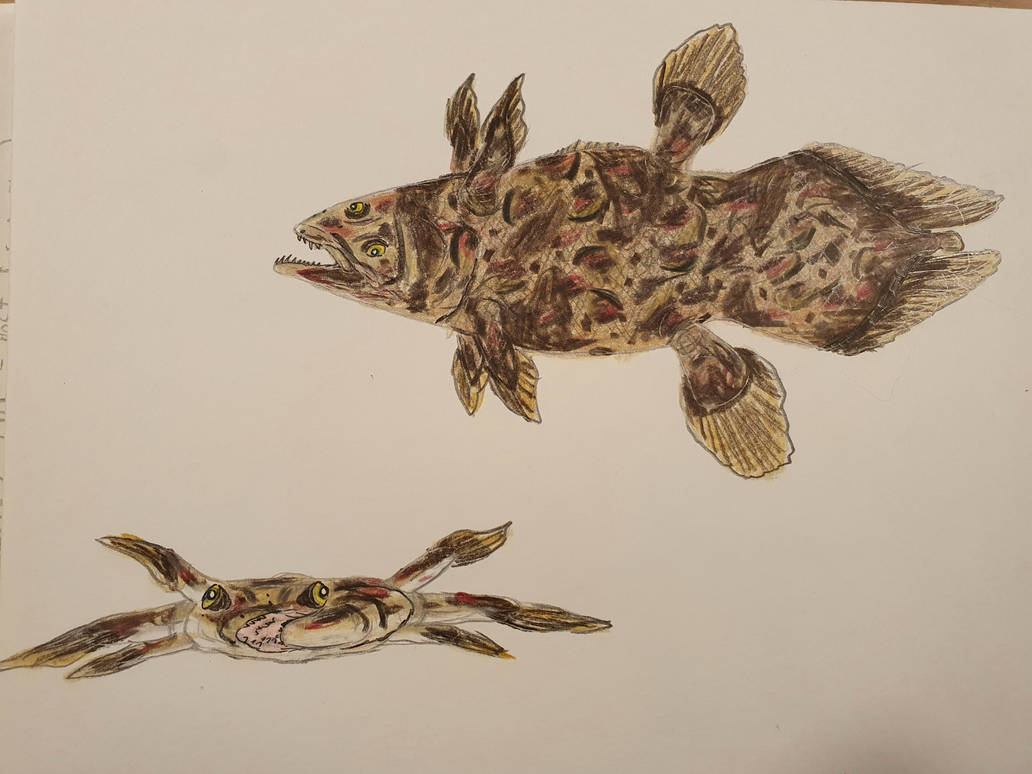
They saw an adult Brown Ebusoir (Syntrivodon fuscus), a large durophagous marine Arachnothere belonging to the Ulmotheria, being assaulted by a gang of Collared Ritsuara's (Fermourodus collaris).

No one had ever seen Ritsuara's gang up on a much larger creature like this before. But they were not just harassing it, they were hunting. While we were aware that this particular species of Fermourodontid had more triangular and slightly more serrated teeth than most others in the genus Fermourodus, we did not know what they used these for.
But now it became clear.
While other Ritsuara's use their three jawed mouths and seven rows of teeth to chop smaller prey like a guillotine, something Collared Ritsuara's undoubtedly do as well, these Fermourodonts use their more triangular teeth to inflict lacerating wounds on larger prey items.

They do not hunt with just brute force, but rather they aim to weaken their prey and bleed them out to the point where they can no longer fight.

At up to six meters long however, a Brown Ebusoir is no easy pickings. These massive marine Arachnotheres possess eight strong flippers that can easily cause a concussion and have insanely strong jaws lined with rows of teeth designed for crushing the shells of huge sedentary bivalves and large Pectinauts. One well placed bite from an Ebusoir could crush a Ritsuara into a bloody pulp.


Malar-striped Ritsuara

It is no secret that the oceans of Eryobis are filled to the brim with life. You do not have to go far to encounter a marine creature in one way or another.

There are however some animals that prefer to avoid us. Fermourodonts are one such case. 
Their electric senses make have caused them to develop a resentment towards anything man-made with an even remotely detectable electronic signature. Their excellent sense of smell also allows them to distance themselves from us without us ever even knowing they were there.

Because of this, our understanding of how Fermourodonts live is quite limited, but occasionally we get treated with a surprise.


One such surprise was when one of our ROV's was observing a shoal of squidn't like nienktvissen of a yet undetermined species, when a Malar-striped Ritsuara (Fermourodus balatrius) came up from the depth with great speed.

It seems to have used the distraction our ROV caused to perform an ambush on the nienktvissen and provided us with the first time we could witness their hunting methods up close.
Quite brutally, the Ritsuara used its three jawed mouth and seven rows of sharp, blade like teeth to literally slice the nienktvissen in half. Upon closer inspection of the footage, it became clear that the visendal rows on the mandibles and the central row of teeth on the trapezium were larger than the other teeth. When Ritsuara's close their jaws, they essentially become guillotines.

Malar-striped Ritsuara's seem to average at around three meters long, not too large, but definitely big enough to cause some serious harm.


Thursday, 26 June 2025

Mantleback Ritsuara

When you dive into the Voûlic Ocean in the south of Eryobis, there is a good chance you will encounter wildlife in one form or another. 
This south polar ocean has some of the most nutrient rich waters in all of Eryobis and thus is booming with sealife.


One of the most common large animals you can encounter here is the Mantleback Ritsuara (Tristinectes amictus). This medium sized Fermourodontid averages around 3.5 meters in length and is an avid piscivore. 
Its seven rows of small needle like teeth are perfectly suited for catching slippery prey like fish, smaller conodonts and llamplelgans. 

They can often be seen traveling in small pods of related individuals and tend to be found a couple kilometers from shore, although they do sometimes come closer to the coast to hunt or birth.

This species of Ritsuara is one of the friendlier ones we've encountered so far. Like all Fermourodonts, they have an electromagnetic field around their mouths, electric whiskers if you will. Because of this, they tend not to respond all too well to our mechanical equipment.
Mantlebacks, thankfully, will not go out of their way to attack and destroy said equipment...unlike some other species. 
Because of this, we do get a fair amount of opportunities to see them in the wild if we go in the water with just traditional equipment that doesn't really have an electrical signal.

Wednesday, 14 May 2025

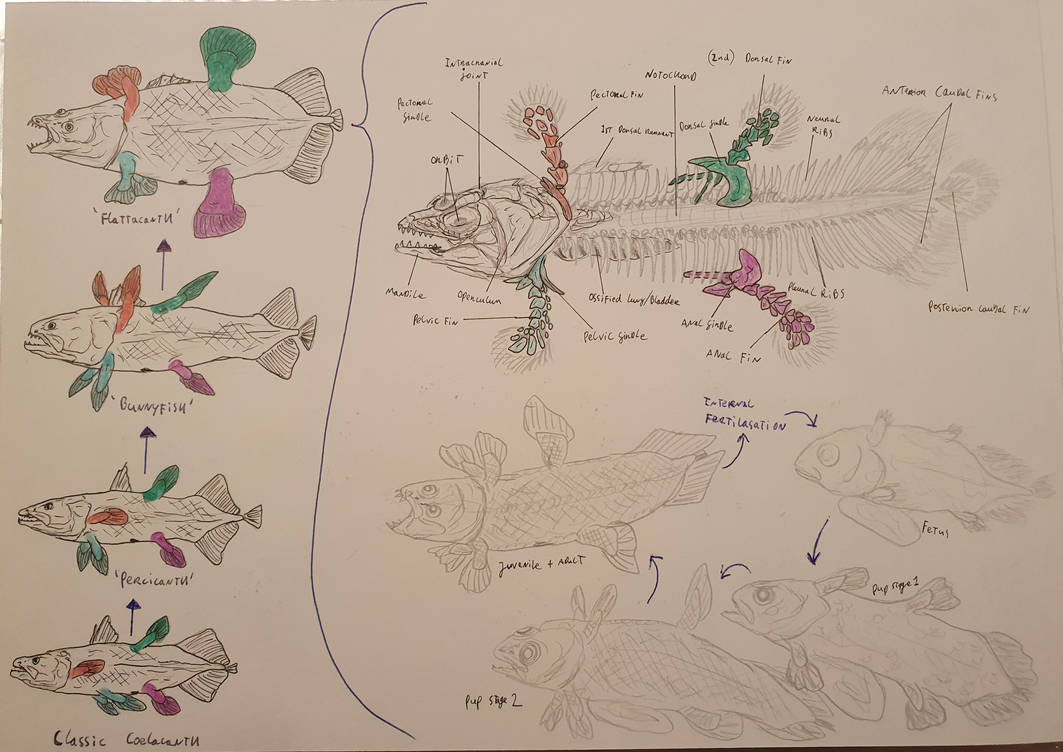
Evolution of the Flattacanths (Planosolincolae)

At some point in the Asthatian period, most likely during the late Agonian stage, Mawsoniid coelacanths of the order Lagotoichthyiiformes (bunnyfish) began adapting to a more benthic lifestyle. 

But, instead of becoming dorsoventrally flattened as most fish would, these already laterally flattened Lagotoichtyiiforms would instead evolve for life on the seafloor in a different way. Akin to the Pleuronectiformes of old Earth, these bunnyfish went through a cranial metamorphosis that saw one of their eyes migrate to the other side. This allowed them to skillfully lay flat on their sides on the sediment, becoming "flattacanths". 


These "flattacanths" became the order Planosolincolae, and rapidly spread around the world as they faced very little competition in this new niche they created for themselves.


Initially they kept to shallow coastal waters and stuck to their niche. But soon they would expand into deeper waters and would even start leaving the seafloor to pursue more mobile prey.


Eventually, Planosolincoles would venture into freshwater ecosystems and start exploring habitats outside the water. This would give rise to the most diverse group of flattacanths today: the terrestrial Anisospondyli. 


Tuesday, 13 May 2025

Survivors of the World Scarring: Terrestrial vertebrates

The devastating mass extinction known as the World Scarring happened around 121 million Eryobian years ago, marking the end of the Bobossic period and subsequently the Prosarmozoic.


Palaeontologists knew for a while that a there had been a massive die off among virtually all organisms at the end of the Kikilian age of the Bobossic period, but weren’t really sure what caused it. The Kikilian-Thyellian boundary is clearly defined as a jet black layer in the rock, but surprisingly there is no iridium to be found here. This ruled out an asteroid impact, but it contains mostly the burned plant material and very little volcanic ash in most places, which means it couldn’t possibly have been formed by volcanic activity. Yet, the layer seems appears in rock formations all over the world and even some marine deposits feature what seems like a burn layer. There is no gradual evolution in deposits from the Kikilian to the Thyellian and animals and plants alike appear to have died rather sudden, which means that whatever caused the extinction happened very quickly. But if asteroid and volcanoes can be ruled out, what could have caused this massive die off?


Scientists started looking for clues and began hypothesising about what might have happened. Some thought it was a big solar storm, others assumed it was a nearby supernova or gamma ray burst. Some thought it was a global fire caused by sudden release of methane in the ground and others thought that a nearby moon came too close to Eryobis and caused tidal forces to burn the surface of the world. There was even a theory that a technologically advanced species caused global warming and climate change as we did back on Earth and perhaps they nuked their world to near extinction. Unfortunately, all of these theories would have left clearer traces if they did in fact happen than what we can actually find.


Then a new theory arose. First thought of by a geologist who was digging in Lotharca and discovered a layer of obsidian that seemed to have been formed at a temperature comparable to the surface of a star and quickly cooled as if exposed to the cold vacuum of space. Curiously, this layer can be found nearly all over Lotharca and even seems to be visible in parts of Rubiëra and appears to line up almost exactly with the Kikilian-Thyellian boundary, be that it seems it cut into Bobossic deposits while Thyellian deposits lie neatly on top. So it appeared that we finally discovered a geological anomaly that correlates with the Kikilian-Thyellian mass extinction, but it only complicated the matter. There is no natural phenomenon that could have literally melted the crust these continents and then let them cool quick enough for this large an amount of glass to form. Besides, there’s no impact sites on that seem to date the same age… or is there?


Turns out there’s a huge nearly straight canyon that runs through the middle of Lotharca. It’s so large in fact that it can clearly seen from space and is one of the most defining features of Eryobis. It appears like a scar on the world and is not surprisingly called the World Scar. Due to its size and shape, we assumed it was the result of tectonic forces ripping the plates in Lotharca apart. A recent scanning of the surface of the world however revealed that Lotharca is pretty much a single solid plate there are no boundaries even near the World Scar. This had led to the formulation of a theory that is equally outlandish as it is horrifying: the Kikilian-Thyellian extinction event was caused by an alien weapon.


While to many it sounded absolutely ridiculous at first, quick came the realisation that this very world we stand on was created by extraterrestrial beings with powers beyond our comprehension. It also wouldn’t be the first time we have encountered the effects of alien technology. On several of our colonised worlds we found traces of ancient civilisations and then ofcourse there’s the screaming case of the alien mega station that has led humanity to many of its current advancements, though its existence has been forgotten by most.


Then came the question: why? Why was an ancient super weapon fired against Eryobis? The answer that most seem to agree on, is that it wasn’t. Instead, they propose the projectile was once shot in an ancient battle fought by forgotten civilisations in an unknown part of the galaxy. The projectile could have travelled countless years through the emptiness of space before it eventually came to Eryobis by accident. The formation of the World Scar suggests the projectile merely scraped the surface of the world, but still managed to cause a mass extinction that is only rivalled by the Permian-Triassic extinction of Earth in severity, except far more sudden. The amount of energy this projectile must have carried is most likely incomprehensible to us humans. While we ourselves do not possess such weaponry, the projectile that caused the World Scarring would have been fired out of a “planet killer”, a weapon with enough power to vaporise the crusts of planets or outright destroy them.


We can see this in the soil turned glass found all over Lotharca and parts of Rubiëra. The projectile sliced through the atmosphere and likely formed a huge hole over the impact that exposed the molten surface to the coldness of space for just a moment. The impact vaporised the entire top 200-500 meters of water in a 500 kilometer radius and might have even set the atmosphere itself ablaze, sending a burning shockwave around the globe that would have consumed all organic matter in an apocalyptic inferno. Nearly all life on the surface of Eryobis seems to have been killed off almost instantly.


Yet, evidently, some survived. Flora might have survived in the form of heat resistant spores and seeds that had already settled in the ground on the opposite side of the globe compared to where the impact happened.

The animals on land seem to offer a clue as to why they even survived in the first place. While we have very little remains of the actual creatures that made it through the apocalypse, their descendants that took over after the dust had settled often show adaptations for digging. Moreover, fossils from the latest Kikilian indicate that the World Scarring happened during northern hemisphere winter and impacted the Lotharca which at the time was closer to the South Pole than it is now. This means that most of the surviving terrestrial animals were likely either fossorial or hibernating near the North Pole, thus escaping the blazing shockwave and not being affected by the extreme heat as much as the rest of Eryobis was.


 As was previously stated, we actually have very few remains of the actual survivors, but we have been able to mostly deduct what they likely looked like based on their descendants after the World Scarring and relatives from the Kikilian.


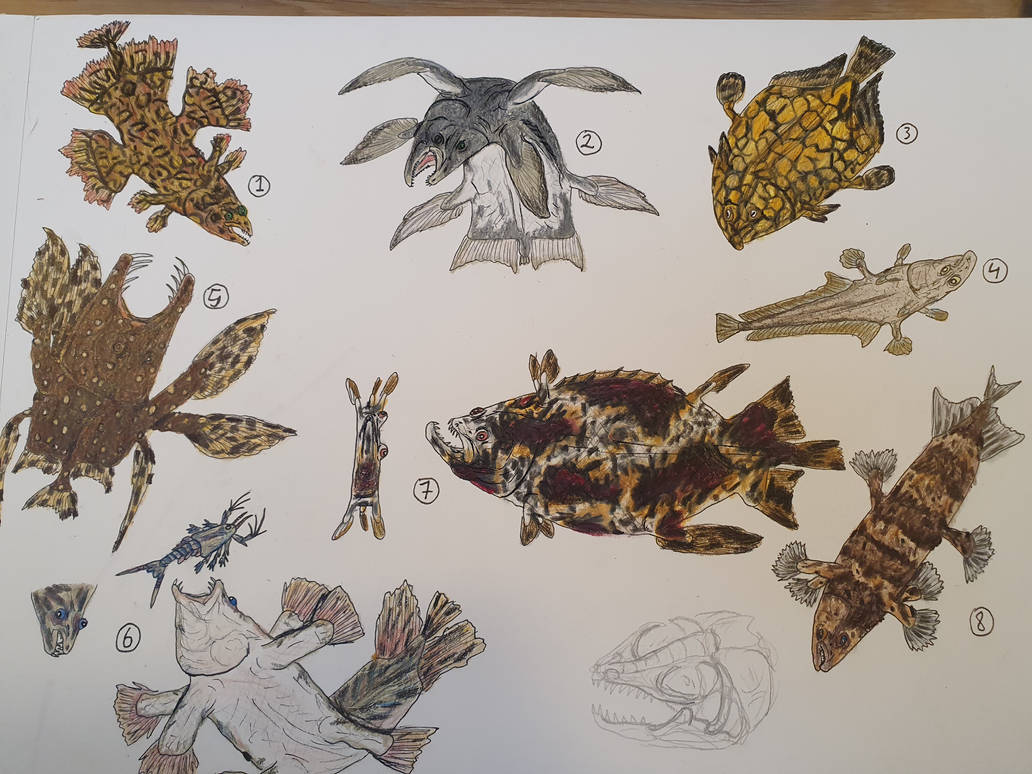
1. A single kind of Dextrotselan Anisospondyl appears to have survived the apocalypse, but it did not much resemble its more famous Dextrotselan cousins like the Aurispinids. Instead was a serpentine creature that likely lived somewhat like a caecilian. (Has no living descendants)……


2. Three lineages of Brachiostomatan Anisospondyls managed to make it through the World Scarring. A fraction of their previous diversity, but it was this diversity that allowed them to survive in the first place. The first of these three was a Folicervauridian, a kind of Brachiostome that has a single ear located on the visendal side right behind the head. We know the surviving member also had such an ear because it was already present in its relatives in the Kikilian. (Has a handful of living descendants)……


3. The second of the three was also the only ear-sail-backed animal to make it through the apocalypse. While sails were a somewhat common sighting in the Prosarmozoic, the Akinitotosaurs are the only Anisospondyls with sails in the Afthonozoic. Apparently the last of many groups of Anisospondyls to evolve a sail-for-an-ear, they are also the last ones to survive. (Has a handful of living descendants)……


4. The third Brachiostome lineage to survive was also the shortest lived. While the other two lineages have member surviving into the present, the Jerounopetonids did not make it beyond the early Farathenian. While Brachiostomes were never able to reclaim the dominance and diversity they had during the Bobossic, the Jerounopetonids did honour their ancestry by becoming some of the largest animals to have ever walked upon Eryobis, with some fossils suggesting a shoulder height of over 5 meters and a weight of up to 30 tons. (Has no living descents)……


5. A Mesotolophid, a kind of Kleisopneumoid Anisospondyl with a row of filaments on the lateral line to aid in detecting sound. (Has no living descendants)……


6. A Kinetognath, a kind of Pleurotaridan Anisospondyl quite closely related to the Cryptognaths. However instead of a second set of jaws, Kinetognaths had jaws that moved like a ball joint to aid in holding and chewing food. (Has no living descendants)……


7. A basal Trapezostomatan Anisospondyl. This lineage is especially obscure because the earliest evidence of their survival only appears over 12 million years after the World Scarring, so the appearance of the survivor remains somewhat unclear. (Has some living descendants)……


8. A Liomedactylomorph Trapezostome. The ancestor of all Liomedactyls that we can see today, the animal that survived the apocalypse was probably already mesothermic and had some form of filament covering. (Has many living descendants)……


9. A basal Cryptognath Pleurotaridan. While the exact reasons are unknown, it’s apparent that Cryptognaths were the winners of the apocalypse, surviving with 4 different lineages of which even the most basal lineage still remains today. Cryptognaths are best known for their second set of jaws composed of the tongue and freed palate. (Has a handful of living descendants)……


10. One of the most important groups of animals today appears to had already evolved before the World Scarring: the Eusymmetrodactyl Cryptognaths. Already being fully homeothermic back then, the Eusymmetrodactyls of today show a staggering diversity and are the most specious clade of Anisospondyls ever. (Has many living descendants)……


11. While likely not a true Parasymmetrodactyl Cryptognath, the animal that survived the apocalypse must have been a close relative as the Parasymmetrodactyls evolved within 10 million years after the dust settled. (Has many living descendants)……


12. The last lineage of Cryptognaths to survive was the ancestor of the Effingodactyls, one of the most diverse clades of Anisospondyls ever, surpassed only by the Eusymmetrodactyls. (Has many living descendants)……


13. Ancestor of the Dactylouran Arachnopods, it’s a bit unclear how a largely arboreal animal managed to survive the inferno, but perhaps they hibernated underground. (Has some living descents)……


14. The ancestor of the Euarachnopods that dominate over all other Arachnopods today. It was probably a lizard like animal that digged for food and safety. (Has many living descendants)……


15. An obscure kind of non-Euarachnopod that also appears to have survived the World Scarring, they appear rather sudden and disappear from the fossil record soon after. (Has no living descendants)……


16.  A kind of very basal serpentine Arachnopod, a distant relative of creatures like Maxillolonchodonts, they only lived for a short time before going extinct all together. (Has no living descendants)……


17. Two types of Pulvinopods survived the World Scarring, which is rather miraculous given their semi aquatic lifestyles. They might have survived by being buried in the mud in riverbeds, but that remains speculation. One of the these survivors was the ancestor of today’s Polytryposternids, a group which was quite diverse early in the Afthonozoic but gradually declined due to competition from other groups of animals. (Has a handful of living descendants)……


18. The other surviving Pulvinopod was the ancestor of the Neopulvinopods that occupy most niches we’d associate with Lepospondyl amphibians on Earth. (Has many living descendants)……