Showing posts with label Holostei. Show all posts

Friday, 30 May 2025

Cladistics: Arachnopoda

There are few creatures as synonymous with the name Eryobis as the Arachnopods. These aptly named eight legged terrestrial vertebrates can be found in nearly every corner of Eryobis and are perhaps even more recognizable than the Anispondyls they share the land with.

Nearly all Arachnopods share a similar basic body plan as they all have vaguely tetrapod like heads on bodies supported by eight spider like legs. But they are no tetrapods, nor are they even closely related. Matter of fact, they're not even Sarcopterygians. They are ray-finned fish of the order Holostei, which on Earth were represented by bowfin fish and gars.>
Arachnopods look rather little like their terran counterparts however, so how did they come to be?

Arachnopoda are part of the Octopodichthyes, a member of the "spiderfish" clade. It is hard to determine if spiderfish are a natural group or if its various members evolved their legs independently since we only observe one other taxon of spiderfish alive today, and those have four legs instead of eight.
Spiderfish in general often fossilize poorly, so we do not know a lot of their early history compared Planosolincolans, which tend to fossilize a lot better.

It is theorized that spiderfish evolved their legs when they separated a number of pelvic finrays from the main fin in order to prod the sediment for sustenance. This would have later led to them moving around on their free finrays until they developed into proper ossified legs. 

At some point, probably in the late Narthian period, some Octopodichthyans made their way to land and would give rise to the Arachnopods we are familiar with today.


As their legs sprouted from the pelvic girdle, Arachnopods needed to hypertrophy their hips in order to support their weight on land. Their pectoral fins on the other hand atrophied since the no longer really served a use on land. 
Many Arachnopods heavily reduced them or lost them completely, while one group known as the Osteotarida modified their pectoral fins to aid in detecting sounds, essentially turning them into ear pinnae.

Because of their massive pelvic girdles, that sometimes heavily resemble the plastrons of turtles, Arachnopods usually have rather stiff torsos. Their eight sprawling legs somewhat negate this issue however, since they provide the animals with a lot of mobility in several directions.

A rather peculiar feature of Arachnopods are their skulls. More specifically, their jaws.
Many Arachnopods have a unique jaw mechanism wherein both the maxilla, premaxilla are separated from the cranium and a dentary that is not connected to the rest of the mandible.
The maxilla is connected to the cranium with a joint that allows it to swivel and is able to slide in a groove in the mandible where a number of muscles and tendons connect to it, creating a "deadbolt mechanism" where the jaw can be locked at a certain angle.
When the maxilla swivels, it usually also causes the premaxilla and dentary to move.

We do not completely understand why this strange jaw mechanism evolved, but we do know that it adds a lot of strength to their jaws opening and closing.


Modern Arachnopods can for the most part be categorized as belonging to one of three groups: Dactylourae, Euarachnopoda and Pulvinopoda.

While the first two likely descend from a single ancestor that survived the catastrophic mass extinction known as the World Scarring, Pulvinopoda appears to have come from two distinct survivors of that cataclysm. Of these two lineages, the Neopulvinopods are the most successful and widespread while Polytryposternians are quite restricted in where they occur nowadays. Hence why Arachnopods are typically placed in one of three categories instead of four.

Pulvinopoda are considered to be the most primitive of the living Arachnopods. They are all ectothermic, often scaleless, amphibian like creatures that lack ear pinnae. Calling them basal would be an insult however. Their skull morphology is highly divergent from the earliest Arachnopods and has close to zero resemblance to those of the other Arachnopod groups.

The Dactylourae are perhaps the oddest of the Arachnopods. These almost exclusively arboreal creatures are most easily recognized by the claw at the end of their tails. While a number of basal genera still exist, most Dactylourans can be placed either within Kremasmasauria or Aioratheria. 
Kremasmasaurs are reptilian or and serpentine in appearance and often completely lack ear pinnae. 
Aioratheres are homeothermic and are typically covered in filaments, which are actually hair like keratin projections of the scales underneath.
Where the other Arachnopods ruled the land, the Dactylourans adapted by specializing in the arboreal lifestyle, being among the very few Arachnopods with an affinity for climbing.

The Euarachnopods are what most explorers first image when they hear the word Eryobis.
These Arachnopods tend to grow much larger than their other relatives, live mostly on the ground and are not dependent on close proximity to water for survival, so they are often much more easy to spot.
While basal Euarachnopods look rather similar on the outside, one can quickly determine their origin by examining their skulls. Usually, they can either be placed in Pseudozygomia or Panhesparachnes.
Both these groups have a temporal fenestra in their skull, but they evolved them independently and from different structures.

Pseudozygomians evolved a fenestra by closing a section of the oral cavity in order to create more muscle attachments and to reinforce the skull. Pseudozygomians can mostly be found in the eastern hemisphere of Eryobis, existing in parts of Tlèëa, Lotharca and Rubiëra, with the subgroup Rubiarachnes being almost exclusively restricted to Rubiëra.

Panhesparachnes evolved their fenestra by forming a bony ring to give more support to the eye and thus essentially splitting the orbit in two. Basal Panhesparachnes often don't have a completely formed fenestra, but all members of Arachnotheria do.
Arachnotheres, the famous spider beasts of Eryobis, are fully endothermic and like the Aioratheres, are covered in hair derived from thin projections on their scales.
Arachnotheres can be found on every continent except Rubiëra and possesses a great number of families, but most of them can be placed in Bloëcatheria, Kentrotaria or Hesparachnes.


Tuesday, 13 May 2025

Survivors of the World Scarring: Aquatic vertebrates

The devastating mass extinction known as the World Scarring happened around 121 million Eryobian years ago, marking the end of the Bobossic period and subsequently the Prosarmozoic.


Palaeontologists knew for a while that a there had been a massive die off among virtually all organisms at the end of the Kikilian age of the Bobossic period, but weren’t really sure what caused it. The Kikilian-Thyellian boundary is clearly defined as a jet black layer in the rock, but surprisingly there is no iridium to be found here. This ruled out an asteroid impact, but it contains mostly the burned plant material and very little volcanic ash in most places, which means it couldn’t possibly have been formed by volcanic activity. Yet, the layer seems appears in rock formations all over the world and even some marine deposits feature what seems like a burn layer. There is no gradual evolution in deposits from the Kikilian to the Thyellian and animals and plants alike appear to have died rather sudden, which means that whatever caused the extinction happened very quickly. But if asteroid and volcanoes can be ruled out, what could have caused this massive die off?


Scientists started looking for clues and began hypothesising about what might have happened. Some thought it was a big solar storm, others assumed it was a nearby supernova or gamma ray burst. Some thought it was a global fire caused by sudden release of methane in the ground and others thought that a nearby moon came too close to Eryobis and caused tidal forces to burn the surface of the world. There was even a theory that a technologically advanced species caused global warming and climate change as we did back on Earth and perhaps they nuked their world to near extinction. Unfortunately, all of these theories would have left clearer traces if they did in fact happen than what we can actually find.


Then a new theory arose. First thought of by a geologist who was digging in Lotharca and discovered a layer of obsidian that seemed to have been formed at a temperature comparable to the surface of a star and quickly cooled as if exposed to the cold vacuum of space. Curiously, this layer can be found nearly all over Lotharca and even seems to be visible in parts of Rubiëra and appears to line up almost exactly with the Kikilian-Thyellian boundary, be that it seems it cut into Bobossic deposits while Thyellian deposits lie neatly on top. So it appeared that we finally discovered a geological anomaly that correlates with the Kikilian-Thyellian mass extinction, but it only complicated the matter. There is no natural phenomenon that could have literally melted the crust these continents and then let them cool quick enough for this large an amount of glass to form. Besides, there’s no impact sites on that seem to date the same age… or is there?


Turns out there’s a huge nearly straight canyon that runs through the middle of Lotharca. It’s so large in fact that it can clearly seen from space and is one of the most defining features of Eryobis. It appears like a scar on the world and is not surprisingly called the World Scar. Due to its size and shape, we assumed it was the result of tectonic forces ripping the plates in Lotharca apart. A recent scanning of the surface of the world however revealed that Lotharca is pretty much a single solid plate there are no boundaries even near the World Scar. This had led to the formulation of a theory that is equally outlandish as it is horrifying: the Kikilian-Thyellian extinction event was caused by an alien weapon.


While to many it sounded absolutely ridiculous at first, quick came the realisation that this very world we stand on was created by extraterrestrial beings with powers beyond our comprehension. It also wouldn’t be the first time we have encountered the effects of alien technology. On several of our colonised worlds we found traces of ancient civilisations and then ofcourse there’s the screaming case of the alien mega station that has led humanity to many of its current advancements, though its existence has been forgotten by most.


Then came the question: why? Why was an ancient super weapon fired against Eryobis? The answer that most seem to agree on, is that it wasn’t. Instead, they propose the projectile was once shot in an ancient battle fought by forgotten civilisations in an unknown part of the galaxy. The projectile could have travelled countless years through the emptiness of space before it eventually came to Eryobis by accident. The formation of the World Scar suggests the projectile merely scraped the surface of the world, but still managed to cause a mass extinction that is only rivalled by the Permian-Triassic extinction of Earth in severity, except far more sudden. The amount of energy this projectile must have carried is most likely incomprehensible to us humans. While we ourselves do not possess such weaponry, the projectile that caused the World Scarring would have been fired out of a “planet killer”, a weapon with enough power to vaporise the crusts of planets or outright destroy them.


We can see this in the soil turned glass found all over Lotharca and parts of Rubiëra. The projectile sliced through the atmosphere and likely formed a huge hole over the impact that exposed the molten surface to the coldness of space for just a moment. The impact vaporised the entire top 200-500 meters of water in a 500 kilometer radius and might have even set the atmosphere itself ablaze, sending a burning shockwave around the globe that would have consumed all organic matter in an apocalyptic inferno. Nearly all life on the surface of Eryobis seems to have been killed off almost instantly.


Recent studies have shown that the aftermath of World Scarring would have been far more destructive than previously thought. All the water that was vaporised in the impact would have rained down and caused deluges of biblical scale as soon as the atmosphere cooled down again, which further explains why there were so ridiculously few animal species on land that made it through.

And while we previously thought that the oceans had been mostly spared save for the surface waters, new evidence suggests that the extinction would have been just bad, if not even worse in the oceans as it was on land. We knew that all surface waters evaporated instantly when the projectile struck killing of most life in the photic zone and all freshwater organisms, but the aftermath would have been even worse. The removal of the at least the top 100 meters of surface waters around the world would have disrupted and destroyed all major currents. And while the rest of the water would not have been vaporised, it would’ve boiling hot for another 100 or so meters down, killing all that lived there. On top of that, the massive displacement of so much water created a vacuum and pulled waters towards Lotharca from all around the world. Deep sea environments would have been completely destroyed as incredible suction forced pulled them from the depths. Then there were the deluges on land, whose water would was not as salty as the sea but carried massive amounts of debris, further causing turmoil in oceans around the world.


If what our simulations suggest actually happened, it’s a miracle anything survived at all. To test the theory, researchers went out and started comparing the genetic material of fish alive today. What they found was horrific. They discovered that all fish alive on Eryobis today can be traced back to a mere 20-ish ancestors that made it through the World Scarring Event. It’s terrifying to think that out of what must have been over 20.000-30.000 fish species in late Kikilian, only an approximate 20 survived, truly showing how devastating the extinction really was.

With this in mind, archeologists went looking for fish fossils from the early Thyellian and indeed, they found 19 clearly distinct genera that appear after the World Scarring.


1-7. Seven of these survivors were Conodonts. Known mostly from their tooth remains, but they were apparently so abundant in the Thyellian that we have more than a few soft tissue fossils of them. They were all quite small and not much is known about them, all we know is that one of them would give rise to the highly successful “murder-molas” known as Nienktvissen.


8. A small species of Seiomourid coelacanth of the Mawsoniid lineage. Curiously, it appears to belong to the genus Tompouzia, which was already known from Kikilian aged rocks. This makes it so far the only surviving creature with fossil records before AND after the World Scarring. Tompouzia typically measured between 10 and 20 centimetres in length and would’ve fed on crustaceans and molluscs most likely.


9. One single species of flattacanth survived the World Scarring: the Onychepizon micrurus. Its pectoral and pelvic fins were small and sported one large claw-like spike that was likely used to dig and cling onto the seafloor. Its tail was small and narrow and it likely swam with its large dorsal and anal fins. It measured roughly 30 centimetres in length.


10. The only true bunnyfish other than flattacanths to make it through was the Lagoselache durus. A small bunnyfish with a shark-like heterocercal tail that would have most likely fed on small invertebrates. Like all bunnyfish and their flattacanth relatives, they come from the Mawsoniid lineage. It grew between 40 and 50 centimetres in length.


11. There were two types of Baculopterygian coelacanths of the Latimeriid lineage to make it through the World Scarring. The most abundant of these was Truemderia tridorsalis, a small fish that grew to about 16 centimeters long. Like all Baculichthyes, it used its pelvic fins as claspers and intromittent organs.


12. The second Baculopterygian was the far larger Serragingivus primivaeus, a predatory fish that might have been the largest animal to survive the World Scarring. Measuring a whopping 90 centimetres long, it would have been the apex predator of the Thyellian oceans. It had a row of teeth in the middle of its upper jaw that were somewhat reminiscent of Eugeneodonts and like them, it probably would’ve hunted mostly soft bodied animals like Conodonts and small fish.


13. A small (yet unnamed) species of Rokanizid coelacanth of the Latimeriid lineage. It was the only Rokanizid to survive due to its deepwater habitat and durophagous habits, unlike most Rokanizids which were herbivores in shallower waters. It measured between 30 and 40 centimetres long.


14. One of the strangest animals to survive the World Scarring was Xenornithogyrinus mirabilis. This animal could best be described as “a fish, but with extra steps”. This creature was a the larval form of “pectoral-fin-first” Octopodichthyian Volichthyiiformes (flish). The ancestors of X. Mirabilis were flying animals that laid their eggs and lived their early lives in water. This variety however, apparently chose to stay in the water. What’s unclear however, is whether Xenornithogyrinus became neotenic before, or after the World Scarring, as no evidence of similar creatures exists from the Bobossic. It was very small, most measuring under 10 centimetres in length.


15. The only non-Octopodichthyian spiderfish to make it through the extinction was the Tetrapodichthyian spiderfish Ericionaris natans. This spiderfish measured about 5 centimetres long and would have had a similar legspan. From its pectoral fins sprang long tendrils, their function is still unknown.


16. A basal Holostean with uncertain affinities, this small fish would have been a bottom feeder that felt the sediment with its barbels, searching for worms. This fish was called Naglimmia diouros and measured between 10 and 15 centimetres long.


17. Another small basal Holostean fish was Pleurolepion labroides. This fish measured around 10 centimetres long and would have lived near the seafloor, feeding on mollusks,


18. Probably the most abundant fish of the early Thyellian was the Paleoeryoscopelus macrolepidotus. A small and basal Diplorachopteran that is thought to have somewhat resembled lanternfish. The frequency in which their fossils are found suggests they formed great shoals. They measured between 8 and 18 centimetres long.


19. Another kind of Diplorachopteran, but much more advanced. This was Pinnansium dimorphis, a predatory fish that showcased distinct sexual dimorphism. The males had a distinct spine on their first dorsal fin that curved forwards, had a long gonopodium on their anal fin and measured 50 centimetres long on average. The females lacked the spine on the first dorsal fin, had no gonopodium and measured 60 centimetres long on average. The large spine of the males likely served as display organ and may have been used by the females to hold onto during mating. They would have preyed mostly on smaller fish.


Earliest fossil animals

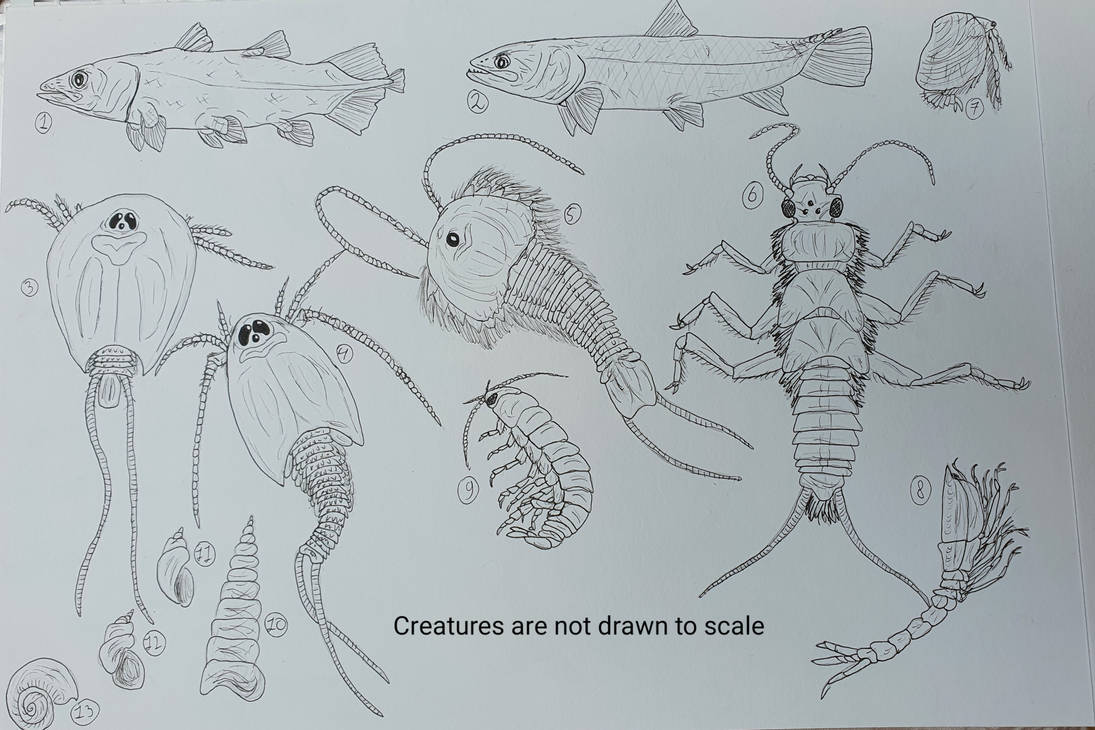
 "It has become very clear to us that AnVela Koeliv-C-VI, commonly known as Eryobis, was in fact seeded with life from Earth a very, very long time ago. Whatever beings brought life here, left little trace of their activities, which has made determining the exact point life started here hard. While we have found fossils from the earliest ages that appear to be fungi or algae, we had no fossils of animals from that time.

That was, atleast, until we came across this Lagerstätte in North-Eastern Guralta. Dated back at 323.6 million years ago, the fossils found here are the oldest evidence of animals on Eryobis.
At the time, this Lagerstätte would've been a brackish estuary and housed a variety of different creatures. The plant life found here is not too different from older fossils, but rather, it's the animals that make this site so important. Some of them have actually been classified in a genus found on Earth back in the Triassic or Jurassic, but most of them have no discovered Earthly counterparts, yet."


Here is a quick description of the fauna in the Lagerstätte:

1) Determined to be a member of the genus Holophagus, this coelacanth has been named Holophagus repositus. This species was on average 37 centimeters long, with some huge individuals reaching almost 50 centimeters.

2) While no Earth based genus seems to match this fish, it has been determined that belongs within the Halecomorphi and possibly even within the Amiiformes. For simplity's sake, it was called Eryobamia antiquus. Most individuals were between 15 and 26 centimeters long.

3) While it has no Terran equal, this notostracan has been classified as Lepidurus Eryobensis . This species was very abundant in the fossil site and measured 3 centimeters long, excluding the caudal furcae.

4) The discovery of a second genus of tadpole shrimp proved the theory that all modern Eryobean notostracans descended from two different ancestors. Named Triops macrops, this species was just as abundant as the Lepidurus, but was a little smaller, measuring 2,8 centimeters long, excluding the caudal furcae.

5) The long standing enigma of the one eyed crustaceans has been solved with the discovery of this species. Determined to be a Kazacharthran of a yet unknown Terran genus, it has been dubbed Eocyclops gigas. From its carapace to its the telson, it measured 12 centimeters long.

6) Probably the most common fossil species in the site, this weird insect caught the researchers off guard. For quite some time, they puzzled over what Jurassic insect was completely aquatic, but they couldn't find anything. Then one day a new paleontologist came over, took a look at it, and then pointed out that it was very similar to a stonefly nymph. This raised the question if it was infact a nymph or a neotenous stonefly. Since the atmosphere back then was even more unbreathable for Terran life then it is now, the chance of it already being neotenous is quite big, although the insane numbers they occurred in might have been the result of an extremely low survival rate with almost all of the adults dying once they leave the water. It was named Guraltoperla puerilis, for it has no Earthly counterpart. Most of them were around 2 centimeters long.

7) Easily recognizable, these clam shrimp were very abundant in the site and based on on their morphology, there may have been up to 15 different species in this site alone, however being hard to identify, they are all classified as Conchostraca indet. They ranged in size from 0.3 to 4 centimeters across their valves.

8) Instantly recognized as a Cumacean, however due to its very generic anatomy, it has been hard to classify it. For now it's known as Cumacea indet. The single individual discovered was 2 centimeters long in total.

9) Identified as an Isopod, but it probably behaved more like an amphipod. It has not been classified yet and is referred to as Isopoda indet. It was 1 centimeter long in total

10-13) Various gastropod shells have been found here, no of which have been properly identified.

"Strangely enough, no brachiopods or bivalves have been found here, leading to the theory that all the original shellfish must have been exclusively marine."

"Even though the species in this Lagerstätte paint a good picture of what the earliest ages on Eryobis would've looked like, according to the genetics and some other modern species, the ones found here appear to be less than half of the introduced species. So all we can do is hope we ever find a similar fossil site, but in an exclusively marine or freshwater setting..."

Frouren Formation


 “Late in the afternoon, a lone male Eoceratanoderes walks through a small Floridophycean forest in what will one day be southwest Tlèëa. A trio of Spikechin “flish” flies by while an inconspicuous Archeoglossgnathus yawns, as she wakes up for a night of hunting.”

Roughly 145 million years ago, Eryobis was a very different place.
There were no Stauropterygians, no Enantiopterans and no Skysquirts filling the air. Back then the continents laid very different and all land vegetation was still exclusively shades of red.
This was the Björnbergian stage of the Bobossic period. During this time, many things started to change. The last remnants of dominant fauna from the Phylloceous had faded away or had been replaced by newer generations as the climate shifted.

The old generation of megafaunal herbivores had started fading away. In the gap they left behind, a more advanced type of herbivore arose: the Ceratanodirids. These were medium to large sized herbivorous Brachiostomatan Anisospondyls, often characterised by having a single horn located behind the eyes, in front of the visendal spiracle that were the dominant megafaunal herbivores of the last 30 million years of the First Era. Of this lineage, Eoceratanoderes was among the very first to develop the characterising horn. Standing roughly 70 centimetres tall at the withers, it was quite small compared to its later relatives, but already showed most of the characteristics that would make this family so successful.

145 million years ago, there were no flying Anisospondyls yet. Instead, another kind of vertebrate ruled the skies and had a monopoly on it until the sky itself burned. Often referred to as “flish”, these animals lack a scientific name for they are not a natural group and instead appear consist of at least 2 lineages that independently evolved flight. By far the most successful were the “regular flish”: seemingly typical octopodichthyian spiderfish with enlarged pectoral fins for wings. The species depicted here has evolved a bright blue face for display and a sharp beak and chin spike prying open “bark” to find Cyclopsfly grubs.

But of the three species of vertebrates depicted, only one has living descendants. The small lizard like animal called Archeoglossognathus, was among the earliest representatives of todays dominant kind of terrestrial vertebrates: the Cryptognathan Anisospondyls.
Anisospondyls with their horizontally oriented mouths face one great problem as they grow larger: gravity.
When eating, gravity has a tendency to let the food fall out of the horizontal jaws of Anisospondyls. The earliest Anisospondyls as a result stayed close to the ground, but as plants grew taller, them growing as well was inevitable. Large, fleshy lips have evolved multiple times to prevent food from falling out, but this wasn’t enough for early Anisospondyls. Brachiostomes like Eoceratanoderes turned their caecal front limbs into food manipulating appendages located directly below the mouth to both prepare food and catch anything that might fall out.
Cryptognaths are one of the two surviving lineages of advanced Anisospondyls and are without a doubt the most diverse. They derive their name from the second set of jaws they have hidden within their throats. These jaws are in essence the ossified tip of the tongue and the no-longer-attached-palate sown together by muscle and ligaments. This second set of jaws is used for a wide range of purposes such as holding- and tearing off small chunks of food.
During the Björnbergian, Crypognaths remained small and insignificant under the shadow of the Brachiostomes. But 30 million years later, at the end of the Kikilian epoch, more than 90% of the latter will die out and Cryptognaths will claim the throne as the new dominant vertebrates on land…although not without resistance…

Fossil Profiles: Forever in battle


 “Ever since we first landed on Eryobis, we noticed that dominant macrofauna on land consisted of two very different kinds of vertebrate. Unlike on Earth, where Tetrapods are the only dominant kind of terrestrial vertebrate, on Eryobis there are two: the sarcopterygian Anisospondyls and the actinopterygian Arachnopods.
Anisospondyls appear to have evolved from an aberrant lineage of Eryobean coelacanths colloquially known as Flattacanths while Arachnopods evolved from a group of Eryobean Holosteans known as octopodichthyian spiderfish.”

“For a long time, it remained a mystery how these two vastly different kinds of terrestrial vertebrates could’ve evolved in each other’s presence, considering they would often have to compete for resources.
Molecular data suggests that both of these clades arose around the same time in what is known as the early Phylloceous period, shortly after a sudden global warming event appears to have caused a major mass extinction, particularly in aquatic fauna.
But how this could’ve happened was still uncertain. That was, until we actually started discovering fossils from the early Phylloceous.
Unlike late Phylloceous fossil sites like the Gerritsen Formation, which show a plethora of both primitive Anisospondyls and basal Arachnopods, fossil sites from the early Phylloceous exhibit either exclusively Anisospondyls or Arachnopods as terrestrial vertebrates depending on the location.
This phenomenon brought forth the theory that Anisospondyls and Arachnopods evolved om different continents that were still separated in the early Phylloceous, but collided somewhere in the middle Phylloceous.”

“Over the years, as more fossils were discovered, the support for this theory grew ever more. The continents were given names for easier reference. The one where the Anisospondyls are thought to have come from was called Knoppira and the one where the Arachnopods originated was called Dallckia. Although has not yet been confirmed where exactly these ancient continents were (as tectonic movements over the eons appear to have completely broken them up and spread them across the modern continents), biodiversity in the fossil sites have confirmed that these continents collided in the late Trextian epoch of the early Phylloceous period. As all fossil sites younger than Trextian deposits feature both Anisospondyls and Arachnopods.”

“The collision of these paleocontinents caused an extinction event due to various flora and fauna suddenly competing with each other. But other than a drop in biodiversity in the early Schippelian, there was little evidence of direct interaction between early Anisospondyls and Arachnopods.
That was, until the discovery of a remarkable fossil found in a think layer of ash dated to the latest Trextian 205 million Eryobian years ago.
A nearly complete skeleton of the largest carnivore of ancient Dallckia, the Osteotariomorph Arachnopod Maxillolonchodon giganteus was discovered with broken bones, many bite marks and several teeth still embedded within its bones. But these teeth did not match the shape of Maxillolonchodon teeth. Instead, they matched other loose fossil teeth discovered in late Trextian deposits from ancient Knoppira. These teeth belonged to a great predator that had strangely left no fossils other than teeth. Until now.”

“Roughly 6 meters away from M. Giganteus laid another animal. It was an Anisospondyl, a big one too. It’s peculiarly shaped visendal spines indicated that it belonged to a group Dextrostelan Anisospondyls known as Aurispinidae.
These basal Anisospondyls had their lateral line organ on the visendal side zigzagging through the spines, thus making their entire sail a kind of ear. As an exquisitely well preserved fossil from the late Schippelian species Aurispinax jubatus shows, Aurispinids had a narrow mane of filaments running along their lateral line organ, presumably for amplifying sounds.
But unlike the other, later Aurispinids, the specimen found alongside M. Giganteus was not a herbivore it’s teeth were knife shaped and serrated, just like the teeth found stuck in the bones of M. Giganteus. This made it not only the oldest Aurispinid discovered so far, but also the only carnivorous species. For this reason it was called Protaurispinax carnifex, the absolute apex predator of late Trextian Knoppira.”

“But these fossils show what happened when the two largest terrestrial predators up until that point met each other. As P. Carnifex also had several teeth matching those of M. Giganteus embedded in its bones, it can be concluded that these two hyper-carnivores fought to the death upon running into each other.
As resources grew scarce after Dallckia and Knoppira collided, the large carnivores were forced to scavenge the coastline for washed up animals where they, unfortunately met each other at the foot of an ancient volcano.
It is presumed they both heavily wounded the other and though the evidence is circumstantial, the state of M. Giganteus suggest that P. Carnifex won the initial battle and later either bled out and died or was buried alive in ash from the nearby volcano.”

The Gerritsen Formation

 “Knowing what transpired in the past is crucial for understanding what is happening today. Though when you’re placed on a less than hospitable world where taking your breathing-mask off will end with you drowning in the air, and with very strict laws preventing large scale destruction of native habitat, getting to know what happened in this worlds past is not easy.”


“It is forbidden for us to do targeted fossil excavations in any place other than cliffs and deserts. Because of this, the fossil history of Eryobis largely eludes us. One of the only places where we can actually get a decent amount of fossils without destroying the environment are the coastal cliffs of northern Hatèmica. But these cliffs only show roughly a 5 million year window between 100 and 95 million years ago. Finding any easily accessible fossil sites older or younger is extremely difficult.”

“That is why we were absolutely thrilled when fossils were discovered in an area designated for urbanisation. While laying the foundations for buildings in the settlement that was to be called Gerritsen, they discovered gigantic petrified plant remains accompanied by some fossil arthropods.
It was then when excavation was started and the settlement of Gerritsen was permitted to expand in a different direction.”

“To this day, the Gerritsen Formation is the biggest fossil site on Eryobis. With over 70 identified genera of animals and an even greater amount of plants. This fossil site provides an excellent window of the middle-late Jelkeïan epoch of the Phylloceous period, 176-180 million years ago.
Determined to have been a subtropical forest, it is thought that the main site formed when a flash flood occurred which killed and buried most organisms instantly. This would explain the excellent state some fossils have been found in, with many showing soft tissue and a perplexing amount even preserving pigment.”


1. The largest animal of the fossil site is the Syrinchotid called Dixiphotocanthus brachycorythius. Named after its somewhat double edged sail and its close relationship to the genus Otocanthus, which it was at first thought to be a species of. Preserved with some soft tissue, the animal appears to have had thick, fleshy lips when it was alive and was covered with small, non overlapping scales. The amount of individuals found suggests Dixiphotocanthus lived in small herds and one even preserved pigment cells which revealed the animal was mostly brown in colouration with a number of both lighter and darker spots and stripes.

2. The biggest terrestrial carnivore of the formation, was the early Pulvinopod Gerritsenvenator ingens. With an oversized head and massive teeth, it is thought this animal could hunt both smaller and larger prey alike. Although it wouldn’t have been. Much of a threat to adult megafaunal herbivores like Dixiphotocanthus and Gewapansaurus. Like all Pulvinopods do, it is likely Gerritsenvenator also spent its early life in water and became terrestrial as it matured.

3. An early “modern” Pulvinopod, still needs formal description. Is thought to have been poisonous based on similar looking modern relatives.

4. The second largest terrestrial herbivore in the Gerritsen Formation was also a Syrinchotid. Dubbed Gewapansaurus proboscilabis, after an extraordinarily well preserved specimen showed that it had short, trunk like lips. But not only that, the specimen also preserved pigment. Mostly found to be reddish-brown in color, it had particular large patches of strangely shaped scales.. After being put under an electron microscope, it was discovered that these patches had a crystalline structure which in real life would’ve resulted in a blue color. As only one specimen has been discovered with pigment still “intact”, it is currently unknown if these blue spots were exclusively present in one sexe, or both.

5. Eokleisopneumis loricatus is the earliest known Kleisopneumoid Anisospondyl, the group with includes almost all modern Anisospondyls. It appears to have been an omnivore with sharp defensive osteoderms.

6. Another large herbivorous Anisospondyl was discovered in the Gerritsen Formation the Aurispinid Istiophorosaurus armatus. Istiophorosaurus is so far the youngest known Aurispinid and like it’s ancestors, had a mane of filaments covering the lateral line organ on its sail. While it also had large defensive spikes, their function is yet unknown for no predator of a size that warrants such defence has been discovered in the formation.

7. Present day Eryobis is no stranger to huge arthropods and this was no different in the past. A prime example of this is the huge cumacean discovered in the Gerritsen Formation dubbed Gigantolamprops terrestris. Due to its size and build, it’s thought Gigantolamprops was an omnivorous scavenger that fed on whatever it could find. It’s thick exoskeleton probably defended it against most potential threats in its environment, as it was not built for running away or fighting.

8. While largely in the shadow of the Anisospondyls, Arachnopods did not come without some giants 180 million years ago. Palaeophytodon grandis represents one of the first offshoots of the Osteotarian lineage and the earliest known herbivorous Osteotarian. Characterising for basal Osteotarians, it had a large mast like bone that bordered the not-yet-ossified pectoral fin, together forming pinnae used for hearing. Palaeophytodon had rather long horns, that were probably used for display.

9. Another early Osteotarian discovered here was Iridiotis pachyosteus. It was a medium sized omnivore. What’s most special about it, is that it was discovered with skin impressions which show it had an iridescent green throat, brow and ear pinnae that were used in display. As only one specimen has been uncovered, it’s unclear whether this was omnipresent in the species or just restricted to males.

10. A good number of Brachiostomatan Anisospondyls were discovered in the Gerritsen Formation. It’s thought Brachiostomes first appeared in the early Jelkeïan, about 20 million years before the Gerritsen deposits. They quickly spread and diversified due to the advantage their under-mouth caecal arms gave them in foraging. This one, while still unnamed, would’ve been a small carnivore when alive. It’s believed to be a early relative of the Brachiostomatan carnivores known from Bobossic deposits.

11, 62, 65, 66, 68 and 69 are some of the many basal, small Pulvinopod species discovered in the formation that are all yet to be described.

12. The third largest Brachiostome of the Gerritsen Formation is thought to have been an arboreal animal. Dendrokynichus elisus had long limbs with long fingers and a long tail that appears to have been prehensile. It was probably an omnivore with a preference for herbivory.

13. A small Dextrotselan Anisospondyl yet to be named. Thought to be a relatively close cousin to Aurispinids like Istiophorosaurus.

14. One of the biggest animals of the Gerritsen Formation was the Haligar species Jelkisuchichthys primivaeus. Jelkisuchichthys was previously only known from late Jelkeïan deposits, but J. Primivaeus shows the genus was already around in the middle Jelkeïan. As a Haligar, it was a close relative to the ancestors of all Anisospondyls. It is the biggest predator discovered in the Gerritsen Formation and would’ve hunted by laying in ambush near the water’s edge similar to a crocodile.

15. The discovery of Gerritsegyrinus remipus was quite interesting, for it appears to have been a secondarily aquatic Pulvinopod. As it’s limbs and pelvic girdle were incapable of supporting it on land. It would’ve been a hunter of smaller fish, arthropods and the larvae of other Pulvinopod species.

16. A large Rokanizid coelacanth species yet to be officially named. It’s big jaws would’ve been used to chew plant matter.

17. A yet unnamed Baculopterichthyan, it’s teeth show it was a carnivore.

18. Among the many Brachiostomatans found in the Gerritsen Formation was also an ancestor to the Corripiocetids that would dominate Eryobis’s oceans in the Bobossic. Like it’s later relatives, Gerritsecetus falcarostrum had a horizontally flattened tail and caecal limbs with long claws and spikes for seizing prey.

19. A yet unnamed species of primitive Bunnyfish.

20, 21, 22, 23, 24, 25, 26 and 27 are the largest among the countless basal Cyclopsflies found in the Gerritsen Formation and also the best preserved. These volant Kazacharthrans are yet to be described, but their morphology shows they had vastly different lifestyles.

28. The most common fish in the Formation was Gerritsenichthys pachytholus. This holostean had heavy jaws, with which it probably fed on arthropods and molluscs.

29. An animal with very uncertain affinities, Syncheognathus grandis is one of the most enigmatic animals found in the Gerritsen Formation. For while it has the fin rays of a spiderfish, it has the skull anatomy more reminiscent of an Arachnopod. Some researchers have proposed its a gigantic neotenous “flish”, but there is not enough evidence to back this theory. It was a large carnivore that would’ve hunted whatever could fit in its mouth.

30. Thought to be large primitive Flattacanth species, it is only known from fragmentary remains such as isolated fin bones and skull fragments. It is yet to be named.

31. A more complete Flattacanth found here was Lutambulus tortilis. A quite large fish, it would’ve been a bottom hunter, feeding on smaller animals that swam overhead. Because the vegetation in its habitat was red, it is thought that Lutambulus was reddish in coloration too.

32, 33, 34, 35, 37, 39 and 40 are a number of smaller, primitive Holosteans found in the Gerritsen Formation. Nut much is known about them and they are yet to all be described.

38. This particular Holostean has caught researchers’ eyes because it appears to be a close relative to spiderfish, as several of its pelvic fin rays were ossified. It is yet to be named.

36, 41, 42, 43, 44 and 45 are some true spiderfish found in the Gerritsen Formation. Their number of legs indicates they come a from a variety of lineages, but all are yet to be officially named.

46 and 47 are two relatively large freshwater Cumaceans, but are yet to be described despite occurring in large numbers.

48, 49, 50, 51 and 52 represent the Cyclid fossils found in the Gerritsen Formation. It is unknown whether the smaller specimens are separate species or just juveniles of the larger ones.

53. Probably the heaviest arthropod uncovered in the Gerritsen Formation was gigantic notostracan dubbed Titanopachyaspis gerritseni. This enormous crustacean was probably a scavenger or both animal and plant remains to sustain its huge size.

54. A relatively large, primitive aquatic Kazacharthran, it is yet to be named.

55, 56 and 57 some smaller, but still quite big Notostracans. They are yet to be formally described.

58. Gigantolamprops is not the only huge terrestrial cumacean discovered at the site. A whole different kind of land living cumaceans, that appear to have evolved independently, was also discovered here. Gerrixecaris wilsoni was one of these. It was roughly the size of a football and probably fed mostly on plant matter.

59. A large terrestrial Kazacharthran that is thought to be distantly related to the Cyclopsflies. Proscorpiocaris cyclops was the size of a small cat and, inferred from its mouthparts, was a carnivore. Although it is unknown whether it actively hunted or scavenged for food.

60 and 61 are two of the earliest Osteotarians that adapted for an arboreal lifestyle. Not much is known about them, as both are only known from fragmentary, crushed remains. But judging by their foot anatomy, it is thought they are basal members of, or perhaps are ancestral to the modern Osteotarian clade we call the Dactylourae.

63. A small and slender Anisospondyl. It is unknown what it’s affinities are and it yet to be named.

64. Found inside a huge petrified “tree” where the remains of another gigantic cumacean. A close relative of Gerrixecaris, it was called Dendroastacus xylophagus, as it is thought that the animal had hollowed out the “tree” it was found in itself. Overall, it’s the biggest arthropod of the Gerritsen Formation, but given its rather thin armor and slender legs, probably not the heaviest.

67. Another large Brachiostomatan, the carnivore dubbed Vellicovenator gracilis is thought to be a direct ancestor to the large predators that lived in the Bobossic based on the anatomy of its jaws and limbs. As the second largest terrestrial carnivore after Gerritsenvenator, Vellicovenator would not have taken on as large prey, but would’ve scavenged and was capable of climbing trees, thus likely having a greater array of prey.

70. A smaller relative of Gigantolamprops, it is yet to be described.

71. Based on the anatomy of its skull and spiracles, this Anisospondyl species, named Scoporhynchus vergus, has been determined to be Katoptifylan more derived than the Brachiostomes, but more basal than the Kleisopneumoids. It had relatively long legs and claws, which it probably used to climb and dig with. It is thought that it mainly fed on invertebrates with its slender beak.

72 and 73 are two yet unnamed “flish” of the “Pectoral-fin-first” variety.

74, 75 and 76 are three yet unnamed “flish” of the “Pelvic-fin-first” variety. They appear to have been quite diverse in their niches. The fossil of #76 had skin impressions which showed an intricate spiral pattern of spots on the lower side of the wings.