As such, a lot of newly found marine creatures also get their names from the fishermen that catch them. While they often call in actual biologists for the binominal names, they tend to give their fish common names with sometimes unclear origins, sometimes derived from their own languages, sometimes from what the native Eryobians call them or something else entirely.
A world so similar to our own, yet so fundamentally different. Abandoned by time, rediscovered by mankind. (Best viewed on desktop)
Wednesday, 4 March 2026
Ægiric Ubondo
As such, a lot of newly found marine creatures also get their names from the fishermen that catch them. While they often call in actual biologists for the binominal names, they tend to give their fish common names with sometimes unclear origins, sometimes derived from their own languages, sometimes from what the native Eryobians call them or something else entirely.
Tuesday, 3 March 2026
Red-eye Prosse
Toeing the line between camouflage and extravagant display, the red-eye prosse (Ithopoius coccineus) is a curious little bunnyfish that inhabits seaweed forests off coastal Lachoba. The most striking feature of prosses are their enormous pectoral- and pelvic fins that are normally held against the body, but can be folded out for display. These four large fins have colorations and markings resembling large, red eyes.
Wednesday, 25 February 2026
Black Gladdo
When one goes deep sea fishing in the Vyaris Ocean, a fish that is often caught at mesopelagic depths is the black gladdo (Eryobalepus atratus). This up to 40cm long deep sea bunnyfish seems to be quite common in these deep tropical waters. Stomach contents of these fish have revealed that they are not picky eaters and will feed on whatever they think they can fit in their mouths, which seem to be able to open up very widely and can expand to twice the width of the head.
Thursday, 18 December 2025
Dacruon bathynectes
Tuesday, 16 December 2025
Red Aetchna
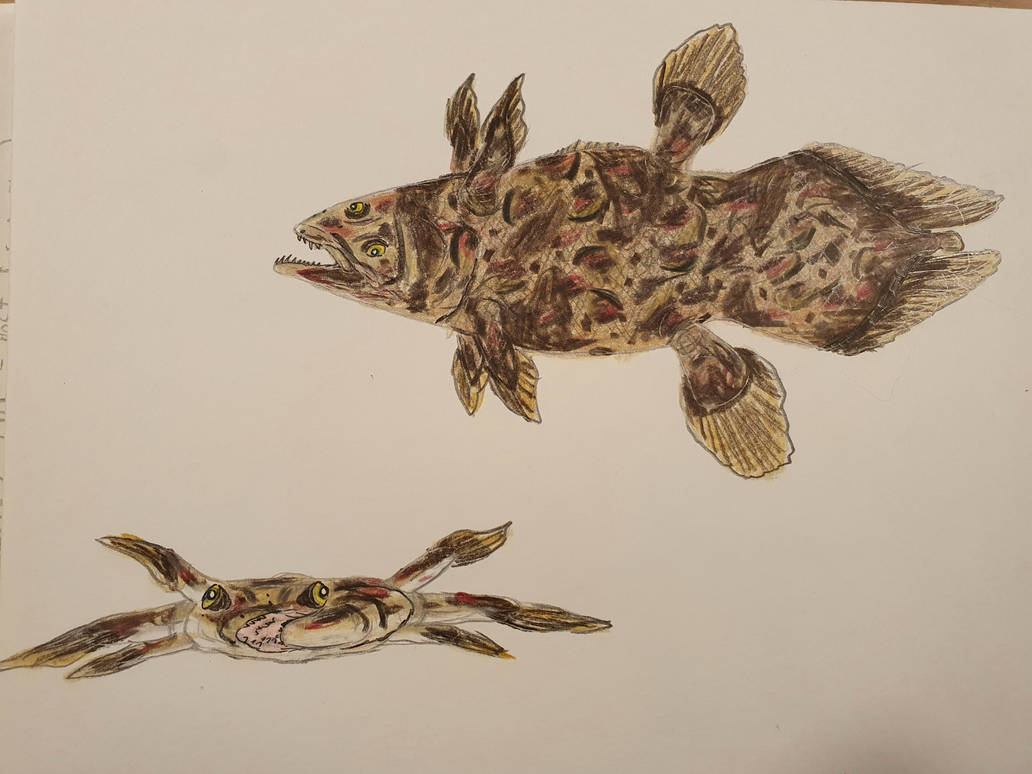
The red aetchna (Lagesox rubicundus) is one of several species of somewhat pike like bunnyfish living in Lachoba. The name "aetchna" is, like many other names we use to designate animals on Eryobis, borrowed from a word that the natives use for it.
Friday, 12 September 2025
Clade overview: Coeaaien and Bunnyfish
![]() |
| Reconstruction of Lagoselache durus, the likely ancestor all coeaaien and kin |
It seems that bunnyfish were hit extremely hard in the mass extinction known as the World Scarring, with most genetic evidence suggesting all modern forms can be traced to a single ancestor that lived around 120 million Eryobian years ago.
Wednesday, 14 May 2025
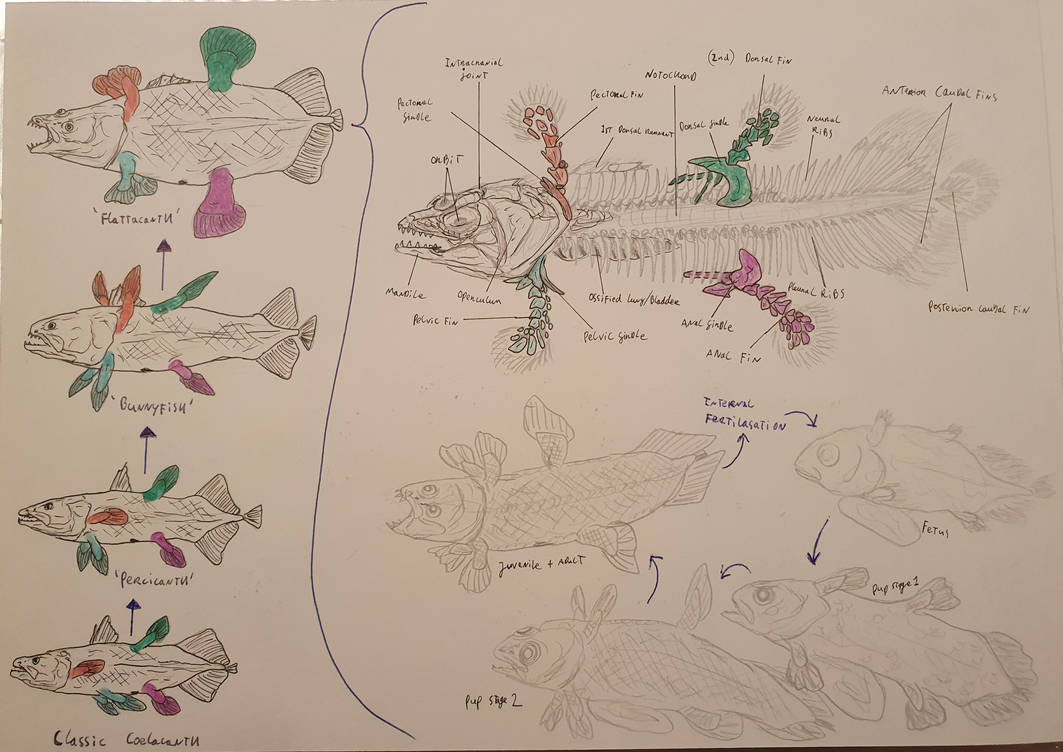
Evolution of the Flattacanths (Planosolincolae)
At some point in the Asthatian period, most likely during the late Agonian stage, Mawsoniid coelacanths of the order Lagotoichthyiiformes (bunnyfish) began adapting to a more benthic lifestyle.
But, instead of becoming dorsoventrally flattened as most fish would, these already laterally flattened Lagotoichtyiiforms would instead evolve for life on the seafloor in a different way. Akin to the Pleuronectiformes of old Earth, these bunnyfish went through a cranial metamorphosis that saw one of their eyes migrate to the other side. This allowed them to skillfully lay flat on their sides on the sediment, becoming "flattacanths".
Tuesday, 13 May 2025
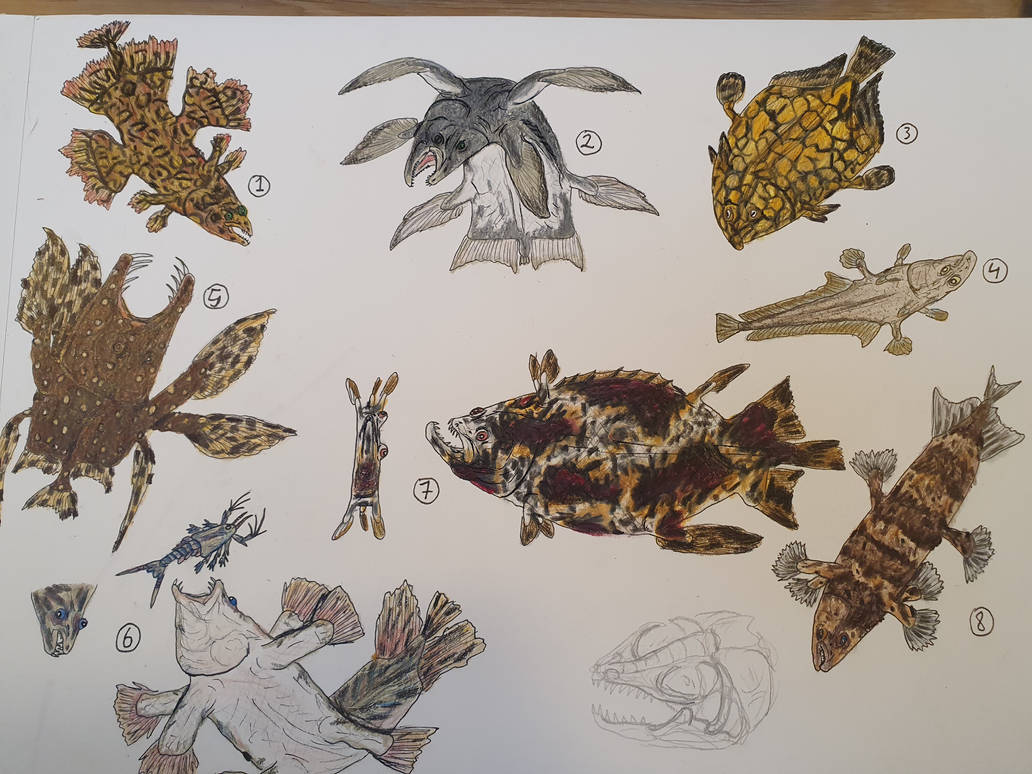
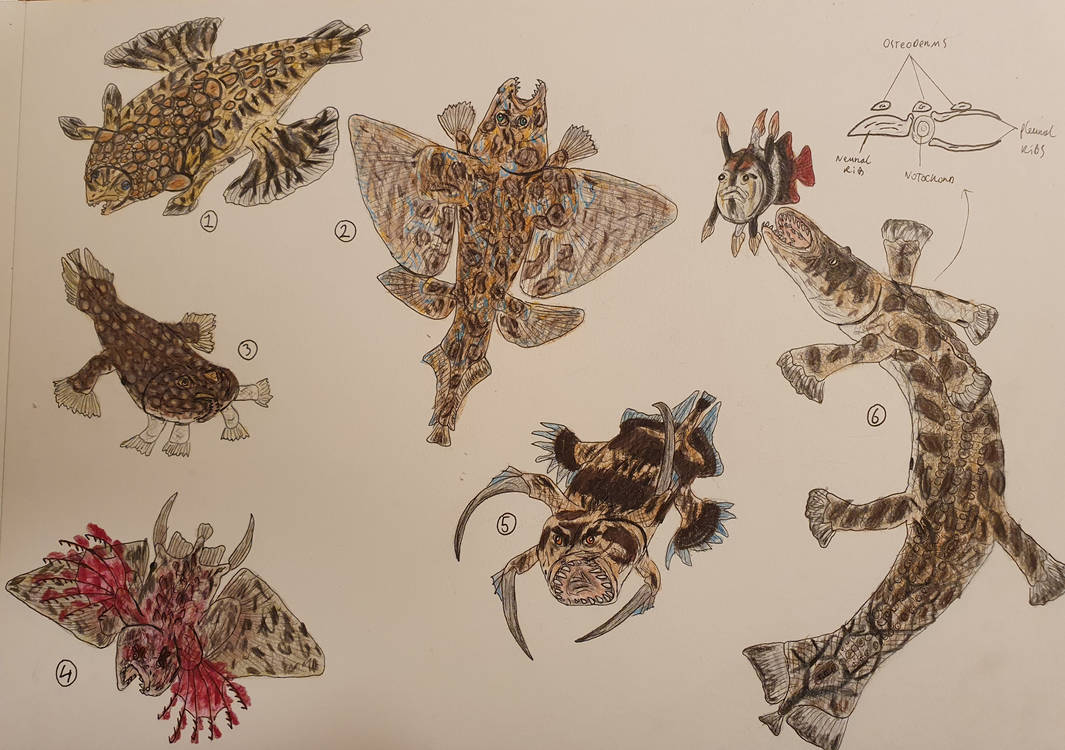
Assorted fossil coelacanths II
1. Not a Bunnyfish, but a late representative of the family Brachysomatidae. This laterally compressed reef fish perfectly demonstrates how the pelvic fins were pushed forward to the skull as a result of their disc shaped bodies. The classic Brachysomatids continued to thrive until their ultimate replacement as dominant reef fish by their Bunnyfish around 33 million P.I. by their Bunnyfish relatives.
2. Since the anoxic event of 25 million P.I. sterilised killed many of the fish that inhabited the early reefs, the Brachysomatids were able diversify and take on new shapes. The Percimorphines were a successful, although short lived, subfamily of Brachysomatids. Their bodies elongated and as a result, they started resembling perch-like fish. In general, they were small to medium sized reef fish that fed mostly on gastropods and crustaceans. Their reign was short, for they were quickly replaced when a family of Holosteans also began to occupy the reefs again.
3. Among those that escaped was the Proto-Bunnyfish, a Percimorphine that had high placed pectoral fins that were most likely used for some sort of display. It escaped by living in estuaries where it hunted smaller fish, biding its time to return to the reefs of its ancestors.
4. In 31 million P.I. the first of the Lagotoichthyiiforms appear, the true Bunnyfish. They are named for their pectoral fins which are placed near the very top their bodies right behind the head, resembling bunny ears. In basal species, these fins are most often used for visual display, either to attract a mate or to warn or confuse predators. Often these fins have vaguely eye-shaped spots on their pectoral fins and sometimes even mouths and teeth shaped patterns on their heads. Bunnyfish became very successful and diverse very quickly and remained successful for a very long time, even surviving to modern times. Exactly what the reason behind their succes is, is unknown, but it might have been their more advanced brains that evolved as a result of their displays.
5. Once the Bunnyfish made their way into the open ocean, they faced a lot of fierce and fast predators. Some adapted by becoming very fast swimmers, while others took to the sky. By evolving their high placed pectoral fins into wing like forms, the “Wingacanths” were able to escape the their assailants from the deep by gliding through the air. Peculiar among this group was the hypertrophied anal fins present in males that served as intromittent organ.
6. While the many non-disc shaped Brachysomatids had already been driven off by newer Holostean competitors, the classic disc shaped species still survived for a while. That was until a new kind of reef fish started appearing. Being more advanced than their Brachysomatid relatives, the new Bucktoothfish quickly outcompeted and replaces them, becoming the dominant reef fish of the second epoch.
7. But Bucktoothfish were not the only Lagotoichthyiforms to invade the reefs once again. Back in their estuary birth grounds, a early Bunnyfish offshoot picked up a taste for hard foods, most notably cyclid crustaceans. For this they developed broad, flat teeth for crushing the carapaces of their prey. When they spread to the reefs, they became more sluggish and adapted to spending large amounts of time on the bottom and as a result, evolved wide pelvic fins to hold onto rocks. But their slow moving lifestyle also made them more vulnerable. In response to this, they developed sharp spines coated in toxic mucus with bright colours to warn any potential threats.
8. Some of the early Lagoichthyiforms became sleek predators with flattened laterally compressed bodies. They hunted in a wide range of habitats; from coastal reefs to the open ocean. Among them were also those that hunted near sandy bottoms and meadows. Mostly preying on small animals buried in the sand, they developed a peculiar hunting style by swimming on their sides to better get close to their hidden prey. It is among the ranks of these specialised predators, that in 43 million P.I. the first Flattacanths arise.
9. The same lineage of Bunnyfish that lead to Flattacanths also lead to group of eel-like Lagotoichthyiforms called Dracanguilids. With long, ribbon like fins and a serpentine body, they remind of oriental dragons. These fish are mostly nocturnal hunters of the reefs and can reach some impressive sizes. As with many other Bunnyfish, their fins re used for display, but instead of sexual or threatening display, they use theirs to hypnotise and stun their prey items by letting their fins dance around.
-
The oceans of Eryobis are teeming with life, from worms that look like straight up aliens to scallops that decided they wanted to be fish....
-
Modern Anisospondyls can be placed into one of three major categories. There are the Brachiostomata , a group which was apparently very div...
-
Modern Anisospondyls can be placed into one of three major categories. There are the Brachiostomata , a group which was apparently very dive...