Showing posts with label Asthatian. Show all posts

Wednesday, 14 May 2025

Evolution of the Flattacanths (Planosolincolae)

At some point in the Asthatian period, most likely during the late Agonian stage, Mawsoniid coelacanths of the order Lagotoichthyiiformes (bunnyfish) began adapting to a more benthic lifestyle. 

But, instead of becoming dorsoventrally flattened as most fish would, these already laterally flattened Lagotoichtyiiforms would instead evolve for life on the seafloor in a different way. Akin to the Pleuronectiformes of old Earth, these bunnyfish went through a cranial metamorphosis that saw one of their eyes migrate to the other side. This allowed them to skillfully lay flat on their sides on the sediment, becoming "flattacanths". 


These "flattacanths" became the order Planosolincolae, and rapidly spread around the world as they faced very little competition in this new niche they created for themselves.


Initially they kept to shallow coastal waters and stuck to their niche. But soon they would expand into deeper waters and would even start leaving the seafloor to pursue more mobile prey.


Eventually, Planosolincoles would venture into freshwater ecosystems and start exploring habitats outside the water. This would give rise to the most diverse group of flattacanths today: the terrestrial Anisospondyli. 


Tuesday, 13 May 2025

Earliest fossil animals

 "It has become very clear to us that AnVela Koeliv-C-VI, commonly known as Eryobis, was in fact seeded with life from Earth a very, very long time ago. Whatever beings brought life here, left little trace of their activities, which has made determining the exact point life started here hard. While we have found fossils from the earliest ages that appear to be fungi or algae, we had no fossils of animals from that time.

That was, atleast, until we came across this Lagerstätte in North-Eastern Guralta. Dated back at 323.6 million years ago, the fossils found here are the oldest evidence of animals on Eryobis.
At the time, this Lagerstätte would've been a brackish estuary and housed a variety of different creatures. The plant life found here is not too different from older fossils, but rather, it's the animals that make this site so important. Some of them have actually been classified in a genus found on Earth back in the Triassic or Jurassic, but most of them have no discovered Earthly counterparts, yet."


Here is a quick description of the fauna in the Lagerstätte:

1) Determined to be a member of the genus Holophagus, this coelacanth has been named Holophagus repositus. This species was on average 37 centimeters long, with some huge individuals reaching almost 50 centimeters.

2) While no Earth based genus seems to match this fish, it has been determined that belongs within the Halecomorphi and possibly even within the Amiiformes. For simplity's sake, it was called Eryobamia antiquus. Most individuals were between 15 and 26 centimeters long.

3) While it has no Terran equal, this notostracan has been classified as Lepidurus Eryobensis . This species was very abundant in the fossil site and measured 3 centimeters long, excluding the caudal furcae.

4) The discovery of a second genus of tadpole shrimp proved the theory that all modern Eryobean notostracans descended from two different ancestors. Named Triops macrops, this species was just as abundant as the Lepidurus, but was a little smaller, measuring 2,8 centimeters long, excluding the caudal furcae.

5) The long standing enigma of the one eyed crustaceans has been solved with the discovery of this species. Determined to be a Kazacharthran of a yet unknown Terran genus, it has been dubbed Eocyclops gigas. From its carapace to its the telson, it measured 12 centimeters long.

6) Probably the most common fossil species in the site, this weird insect caught the researchers off guard. For quite some time, they puzzled over what Jurassic insect was completely aquatic, but they couldn't find anything. Then one day a new paleontologist came over, took a look at it, and then pointed out that it was very similar to a stonefly nymph. This raised the question if it was infact a nymph or a neotenous stonefly. Since the atmosphere back then was even more unbreathable for Terran life then it is now, the chance of it already being neotenous is quite big, although the insane numbers they occurred in might have been the result of an extremely low survival rate with almost all of the adults dying once they leave the water. It was named Guraltoperla puerilis, for it has no Earthly counterpart. Most of them were around 2 centimeters long.

7) Easily recognizable, these clam shrimp were very abundant in the site and based on on their morphology, there may have been up to 15 different species in this site alone, however being hard to identify, they are all classified as Conchostraca indet. They ranged in size from 0.3 to 4 centimeters across their valves.

8) Instantly recognized as a Cumacean, however due to its very generic anatomy, it has been hard to classify it. For now it's known as Cumacea indet. The single individual discovered was 2 centimeters long in total.

9) Identified as an Isopod, but it probably behaved more like an amphipod. It has not been classified yet and is referred to as Isopoda indet. It was 1 centimeter long in total

10-13) Various gastropod shells have been found here, no of which have been properly identified.

"Strangely enough, no brachiopods or bivalves have been found here, leading to the theory that all the original shellfish must have been exclusively marine."

"Even though the species in this Lagerstätte paint a good picture of what the earliest ages on Eryobis would've looked like, according to the genetics and some other modern species, the ones found here appear to be less than half of the introduced species. So all we can do is hope we ever find a similar fossil site, but in an exclusively marine or freshwater setting..."

Evolution of terrestrial Rhodophytes

Rhodophyta (red algae) are among the oldest groups of eukaryotic algae on earth, dating back to Mesoproterozoic Era around 1.6 billion years ago with oldest fossil of a multicellular sexually reproducing organism dating back to 1.05 billion years ago.
Rhodophyta also have notoriously few genes for multicellular eukaryotes, possibly due to a genetic bottleneck they went through somewhere in their evolution.
It is unclear whether this is because their ancestors were extremophiles or because of competition with cyanobacteria and Chlorophytes or a combination of both.
But this lack of genes is has confined them to a mostly marine, aquatic environment, with only 5% of red algae living in fresh water and no terrestrial species except for two single celled cave dwellers.

On the distant world of Eryobis however, Rhodophytes are the only multicellular autotrophic organisms introduced. Here they enjoyed competition free seas and lakes and rapidly diversified in the beginning.
While adaptive speciation played a major role, the engine of their evolution came from above.
In the beginning, Eryobis only had a very weak ozone layer and while it had an atmosphere that had broken the moon free of tidal locking, it was not capable of sustaining terrestrial life from Earth, which it still doesn't.
Besides cosmic radiation and lots of solar radiation reaching the ground, the moon was also bombarded with synchotron radiation emitted form Antæios, the planet that Eryobis orbits.
Eryobis' own magnetosphere was enough to keep the radiation from killing everything instantly, although the ionizing properties of the radiation caused a very high mutation rate, aiding the speciation.

For the Rhodophytes, this was not a bad thing, as the radiation induces several polyploidization events in multiple lineages. In such an event, the entire genome of a species is duplicated, which can lead to greater adaptability, flexibility and diversity.
Where the red algae lagged behind on Earth, they made up for on Eryobis. With genes to spare, they evolved ways that allowed them to colonise many aquatic habitats and even conquer land.

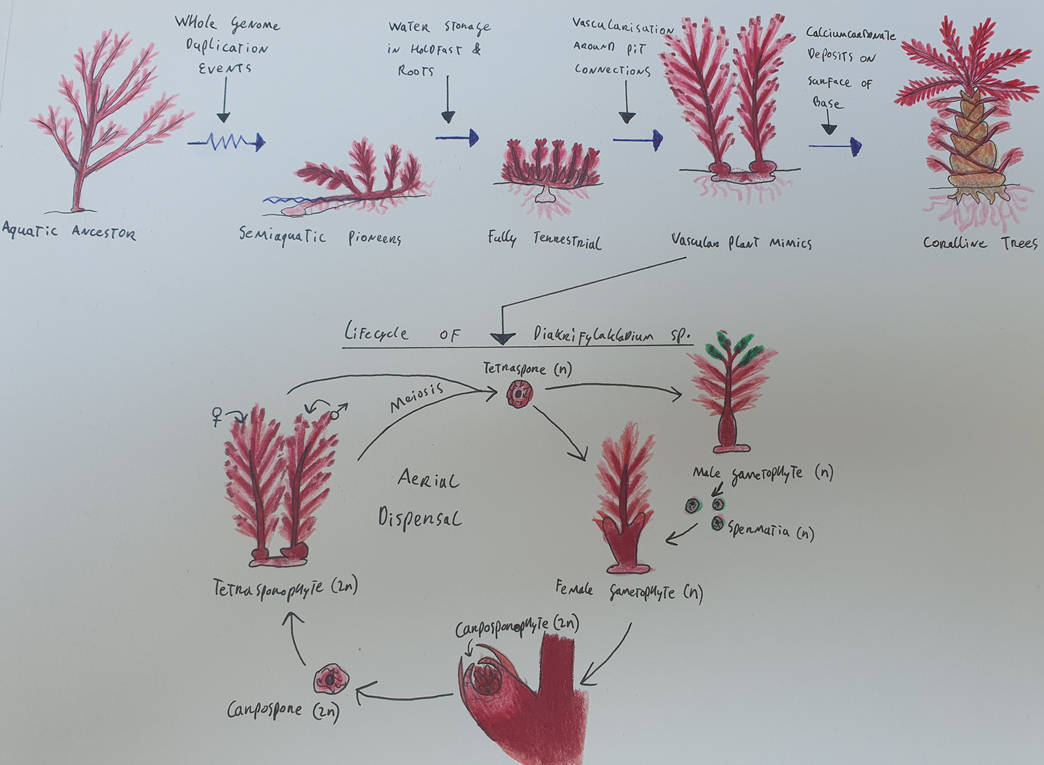
The first adaptation for moving out of the water was the ability to retain moisture in the blades (leaves but actually not) when exposed to air, while the holdfast remained in the water close by. Small projections from the main stem that grew downwards evolved into roots.
As seasons are very extreme on Eryobis, this semiaquatic lifestyle was not going to last long. So they evolved a way to keep vital nutrients and water inside de holdfast, which would be buried in the soil, so that it could act similar to the hump of a camel, or in lesser extent as a tuber. After this adaptation, the terrestrial red plants looked more or less like mosses for quite some time before the next big thing evolved.
Almost all member of the Rhodophyta have incomplete cytokinesis were a small pore is left between the mother and daughter cell. These are known as pit connections, and they often have stop in them known as a pit plug. It still unclear exactly what purpose these features serve, although they may act as structural reinforcement.
In the terrestrial Rhodophytes, the next big adaptation was the evolution of vein-like structures around de pit connections of the cells. The flow of water and nutrients pressurized the cells, which caused the plants to straighten. These vascular plant mimics are the most successful group of land plants on Eryobis, having spread to almost every corner of the moon. They were much taller than their non vascular ancestors, but were still limited in size by the availability of water, with the biggest not growing much taller than 1.5 meters (5 foot). Under severe predatory pressure however, some evolved a hard exoskeleton made of calciumcarbonate deposits strengthened with cellulose. Within only a few million years the skeletons of these coralline plants allowed them to grow far bigger than any Rhodophyte had ever been and massive forest were formed around equatorial regions.


Illustrated below is the simplified life cycle of the vascular plant mimic genus Diakrifylakladium. Rhodophytes have an unusually complex reproductive strategy that allows for a lot of genetic diversity within a species.
The 'main' phase of Diakriflykladium is the tetrasporophyte. In this phase the plant has diploid (2n) genes and it grows two feather like stalks. One of these stalks will only produce male tetrapsores and the other will only produce female ones which will both be released into the air. The tetraspores are haploid (n) and will grow into either a male or a female gametophyte (n) depending on the genetic material. The male gametophyte will produce spermatia (n) in their spermatangia. The spermatia are released into the air where they will hopefully find a female gametophyte, if that happens fertilization occurs in the female's carpogonium. In the carpogonium develops the diploid carposporophyte (2n) which will grow its own spore growing organs called carposporangia. The carposporangia release diploid carpospores (2n) into the air and when they settle, they will grow into the bisexual tetrasporophyte and the whole cycle begins again.


Assorted fossil coelacanths III


 The fish pictured above would’ve lived between 0 and 40 million years P.I. (Post Introduction) and would largely not have coexisted with each other.

1. One of the earliest representatives of the clasper-finned coelacanths formally known as the Baculopterichthyes. These fish have adapted their pelvic fins to function similar to gonopodia or claspers in more derived forms. While the Baculopterichthyes today are among the most successful and diverse of all living fish, they had very humble beginnings and did not get a place in the spotlight until after the greatest massextinction Eryobis has ever seen. The species here would’ve lived in shallow coastal seas somewhere between 3 and 7 million years P.I. being among the very first to sexually select for larger fins that would later be used as intromittent organs.

2. While the land was still barren and devoid of large animals in the early ages of Eryobis, the waters just bordering the land were full of life. Rivers and lakes were very diverse ecosystems and pioneers in adapting to higher radiation levels that were present there. Clouds of Rhodophytic algae and Florideophycean forest stained the shallow waters red. Just as many river inhabitants on Earth are coloured green to blend in with vegetation, so are many creatures that live in Eryobis’ rivers coloured red. In these early crimson rivers, arose some of the most fearsome predators to ever swim. The Smaugpikes were a long-lived group of specialised carnivores that made freshwater systems unsafe between 6 and 84 million years P.I. until they were replaced by a new kind of river monster. They were all red on coloration, often with stripes and spots to help camouflage themselves. They swallowed their prey whole and if that wasn’t possible, they tore their prey to shreds with their double rows of backwards pointing teeth.

3. Another kind of fluvial predators that lived in the early ages was a group known as the Caesodonts. These vaguely shark-like coelacanths lived in murky waters near the bottom where they hunted for crustaceans and benthic fish. They used their exceptional rostral organs to detect electric fields and were this way able to hunt very well in the dark.

4. The Lagotoichthyiforms were not the only coelacanths to inhabit the early reefs. Another group of small fish also started to inhabit the reefs shortly after the anoxic event of 25 million years P.I.. These were herbivores that fed on sea weeds growing between the coral. With their many shovel shaped teeth, the Ptyariodonts made short work of cutting plants and with multiple chambered stomach and long guts, they were able to digest most of the plant matter they ate.

5. A very successful group, the Eelacanths (debut in part 1) spread far and wide after leaving the deep waters they originated from. Coastal zones were a very popular habitat for Eelacanths and they were met with unrivalled success in those shallow waters. Most were migratory, but some made it their permanent home. And strangely, so did Gulper-Eelacanths, a family of normally deep water inhabiting fish that evolved huge mouth to swallow prey with. As they adapted to swallower waters, their bodies became shorter, stockier and more muscular, capable of very powerful bursts of speed to overwhelm their prey. The species depicted above is about to swallow a primitive tadporpion, though the crustacean might be a bit too prickly to handle for the Gulper’s throat.

6. First arising in 21 million years P.I., they began giving the previous top predators, the Coelosphyraenids, some competition until the anoxic event of 25 million years P.I. completely wiped the Coelosphyraenids out. With the former apex predators gone, some surviving big-finned coelacanth quickly rose to the top. These were the Teratobatoids. With somewhat laterally compressed bodies, but with huge flat pectoral fins, they didn’t quite resemble anything on Earth, the closest similarity being to ratfishes. Teratobatoids lived a long time and during their time, they filled mostly what we would consider to be “shark-niches”. Being not the fastest of fish, their domain was mostly restricted to continental waters, as they were unable to compete in the open ocean. Here they reigned for a long time until their eventual displacement as top predators by a new kind of fin-swimming predator.

7. Thunniform bodies are nothing new, as they are the most advantageously shaped bodies for traversing open water. On Eryobis, the Thunnitricids were the first to reach such body shapes. Already being well represented before and really dominating after the anoxic event, they swam the world’s oceans from 18 to 85 million years P.I. when a global warming event got the best of them. These fast swimming predators could reach up to 50 km/h and were the very first animals on Eryobis to evolve partial endothermy.

8. Of the species depicted above, this one is actually the closest to the Flattacanths. It came from an early offshoot of the branch that would lead to Brachysomatids (part 1&2). But instead of living in shallow water reefs, the ancestors of this fish dove down into the deep. Here they became mesopelagic superpredators. Fast paced fish with a wide gape and sharp teeth, few things could escape it once locked as a target. They were the Seiomourids, a family of large carnivores that hunted just above the twilight zone for anything foolish enough to come close, but they had a particular taste for lanternfish-like holosteans and schooling crustaceans. Being adapted to lower oxygen levels, they managed to survive the anoxic event of 25 million years P.I. and went on to thrive long after. Among their ranks, many independently went even deeper into the abyss, causing the strange phenomenon deep sea Seiomourids existing all over the world and yet being unrelated to each other.

Assorted fossil coelacanths II

The species pictured above would’ve lived between 26 and 40 million years P.I (Post Introduction) and some of them would’ve coexisted with each other.

1. Not a Bunnyfish, but a late representative of the family Brachysomatidae. This laterally compressed reef fish perfectly demonstrates how the pelvic fins were pushed forward to the skull as a result of their disc shaped bodies. The classic Brachysomatids continued to thrive until their ultimate replacement as dominant reef fish by their Bunnyfish around 33 million P.I. by their Bunnyfish relatives.

2. Since the anoxic event of 25 million P.I. sterilised killed many of the fish that inhabited the early reefs, the Brachysomatids were able diversify and take on new shapes. The Percimorphines were a successful, although short lived, subfamily of Brachysomatids. Their bodies elongated and as a result, they started resembling perch-like fish. In general, they were small to medium sized reef fish that fed mostly on gastropods and crustaceans. Their reign was short, for they were quickly replaced when a family of Holosteans also began to occupy the reefs again.

3. Among those that escaped was the Proto-Bunnyfish, a Percimorphine that had high placed pectoral fins that were most likely used for some sort of display. It escaped by living in estuaries where it hunted smaller fish, biding its time to return to the reefs of its ancestors.

4. In 31 million P.I. the first of the Lagotoichthyiiforms appear, the true Bunnyfish. They are named for their pectoral fins which are placed near the very top their bodies right behind the head, resembling bunny ears. In basal species, these fins are most often used for visual display, either to attract a mate or to warn or confuse predators. Often these fins have vaguely eye-shaped spots on their pectoral fins and sometimes even mouths and teeth shaped patterns on their heads. Bunnyfish became very successful and diverse very quickly and remained successful for a very long time, even surviving to modern times. Exactly what the reason behind their succes is, is unknown, but it might have been their more advanced brains that evolved as a result of their displays.

5. Once the Bunnyfish made their way into the open ocean, they faced a lot of fierce and fast predators. Some adapted by becoming very fast swimmers, while others took to the sky. By evolving their high placed pectoral fins into wing like forms, the “Wingacanths” were able to escape the their assailants from the deep by gliding through the air. Peculiar among this group was the hypertrophied anal fins present in males that served as intromittent organ.

6. While the many non-disc shaped Brachysomatids had already been driven off by newer Holostean competitors, the classic disc shaped species still survived for a while. That was until a new kind of reef fish started appearing. Being more advanced than their Brachysomatid relatives, the new Bucktoothfish quickly outcompeted and replaces them, becoming the dominant reef fish of the second epoch.

7. But Bucktoothfish were not the only Lagotoichthyiforms to invade the reefs once again. Back in their estuary birth grounds, a early Bunnyfish offshoot picked up a taste for hard foods, most notably cyclid crustaceans. For this they developed broad, flat teeth for crushing the carapaces of their prey. When they spread to the reefs, they became more sluggish and adapted to spending large amounts of time on the bottom and as a result, evolved wide pelvic fins to hold onto rocks. But their slow moving lifestyle also made them more vulnerable. In response to this, they developed sharp spines coated in toxic mucus with bright colours to warn any potential threats.

8. Some of the early Lagoichthyiforms became sleek predators with flattened laterally compressed bodies. They hunted in a wide range of habitats; from coastal reefs to the open ocean. Among them were also those that hunted near sandy bottoms and meadows. Mostly preying on small animals buried in the sand, they developed a peculiar hunting style by swimming on their sides to better get close to their hidden prey. It is among the ranks of these specialised predators, that in 43 million P.I. the first Flattacanths arise.

9. The same lineage of Bunnyfish that lead to Flattacanths also lead to group of eel-like Lagotoichthyiforms called Dracanguilids. With long, ribbon like fins and a serpentine body, they remind of oriental dragons. These fish are mostly nocturnal hunters of the reefs and can reach some impressive sizes. As with many other Bunnyfish, their fins re used for display, but instead of sexual or threatening display, they use theirs to hypnotise and stun their prey items by letting their fins dance around.
 

Assorted fossil coelacanths I


 1. Family: Brachysomatidae. The Barchysomatids are generally small to medium sized, vaguely disc shaped fish that inhabited the early reefs between 19 and 26 m.y. P.I.. Due to their short bodies, their pelvic fins were pushed forward, close to the skull. It’s the descendants of these small reef fish that would lead to the Bunnyfish and eventually, the Flattacanths.

2. Family: Inermonatatoridae. These toothless coelacanths are rather basal, first appearing 5 m.y. P.I. and the were among the first filterfeeding fish of Eryobis. In the beginning they were small, but as competition got more severe, they became huge. The freshwater Red Giant pictured above is the largest member of this family and subsequently, also one of the last. This family went extinct by 17 m.y. P.I. due to competition and predation.

3. Family: Eurygnathidae. The Wideocanths, as they have been nicknamed, were nature’s first attempt at making a flat coelacanth. They did not last long though, as they were purely marine bottom dwellers, without the ability to breathe air, that evolved before plants had even fully colonised land and so they had no escape from a massive anoxic event that sterilised much of the worlds seas. The wideocanths went extinct by 25 m.y. P.I..

4. Family: Gyrinenchylidae. The Eelacanths, as they are called were a successful group of eel like fish that were among the first to adapt to life in the deep. Evolving long bodies for squeezing through rocks and caverns, once they left the deep for more shallow waters, they quickly diversified and thrived for millions of years. They evolved into many different shapes and sizes over their 70 million year existence, but the species pictured above is quite primitive and would’ve lived between 16 and 23 m.y. P.I..

5. Family: Oblongocaudidae. The Oblongocaudids were close relatives of the Brachysomatids, but split off before the latter became reef specialists. The Oblongocaudids were the first to extend the middle caudal fin and even though this is not unique to them, they were the first to do it. The family lasted from 18 to 30 m.y. P.I..

6. Family: Coelosphyraenidae. The Coelosphyraenids were the first pelagic apex predators of Eryobis. First appearing around 7 m.y. P.I. they spent the next 22 milion years at the top of the food chain, after which they became outcompetes by newer predators. The species illustrated is one of the biggest members of the family would’ve haunted the oceans from 15 to 21 m.y. P.I..

7. Family: Rokanizidae. The Rokanizids were probably the Eryobean first fish to become fully herbivorous. Grazing plants on the bottom, they mostly thrive in freshwater were predators are fewer, although saltwater members are not uncommon. They first appeared 5 milion years P.I. and amazingly enough, their descendants have managed to survive to this day, although not completely unchanged.