Showing posts with label Ceratanodire. Show all posts

Tuesday, 13 May 2025

Frouren Formation


 “Late in the afternoon, a lone male Eoceratanoderes walks through a small Floridophycean forest in what will one day be southwest Tlèëa. A trio of Spikechin “flish” flies by while an inconspicuous Archeoglossgnathus yawns, as she wakes up for a night of hunting.”

Roughly 145 million years ago, Eryobis was a very different place.
There were no Stauropterygians, no Enantiopterans and no Skysquirts filling the air. Back then the continents laid very different and all land vegetation was still exclusively shades of red.
This was the Björnbergian stage of the Bobossic period. During this time, many things started to change. The last remnants of dominant fauna from the Phylloceous had faded away or had been replaced by newer generations as the climate shifted.

The old generation of megafaunal herbivores had started fading away. In the gap they left behind, a more advanced type of herbivore arose: the Ceratanodirids. These were medium to large sized herbivorous Brachiostomatan Anisospondyls, often characterised by having a single horn located behind the eyes, in front of the visendal spiracle that were the dominant megafaunal herbivores of the last 30 million years of the First Era. Of this lineage, Eoceratanoderes was among the very first to develop the characterising horn. Standing roughly 70 centimetres tall at the withers, it was quite small compared to its later relatives, but already showed most of the characteristics that would make this family so successful.

145 million years ago, there were no flying Anisospondyls yet. Instead, another kind of vertebrate ruled the skies and had a monopoly on it until the sky itself burned. Often referred to as “flish”, these animals lack a scientific name for they are not a natural group and instead appear consist of at least 2 lineages that independently evolved flight. By far the most successful were the “regular flish”: seemingly typical octopodichthyian spiderfish with enlarged pectoral fins for wings. The species depicted here has evolved a bright blue face for display and a sharp beak and chin spike prying open “bark” to find Cyclopsfly grubs.

But of the three species of vertebrates depicted, only one has living descendants. The small lizard like animal called Archeoglossognathus, was among the earliest representatives of todays dominant kind of terrestrial vertebrates: the Cryptognathan Anisospondyls.
Anisospondyls with their horizontally oriented mouths face one great problem as they grow larger: gravity.
When eating, gravity has a tendency to let the food fall out of the horizontal jaws of Anisospondyls. The earliest Anisospondyls as a result stayed close to the ground, but as plants grew taller, them growing as well was inevitable. Large, fleshy lips have evolved multiple times to prevent food from falling out, but this wasn’t enough for early Anisospondyls. Brachiostomes like Eoceratanoderes turned their caecal front limbs into food manipulating appendages located directly below the mouth to both prepare food and catch anything that might fall out.
Cryptognaths are one of the two surviving lineages of advanced Anisospondyls and are without a doubt the most diverse. They derive their name from the second set of jaws they have hidden within their throats. These jaws are in essence the ossified tip of the tongue and the no-longer-attached-palate sown together by muscle and ligaments. This second set of jaws is used for a wide range of purposes such as holding- and tearing off small chunks of food.
During the Björnbergian, Crypognaths remained small and insignificant under the shadow of the Brachiostomes. But 30 million years later, at the end of the Kikilian epoch, more than 90% of the latter will die out and Cryptognaths will claim the throne as the new dominant vertebrates on land…although not without resistance…

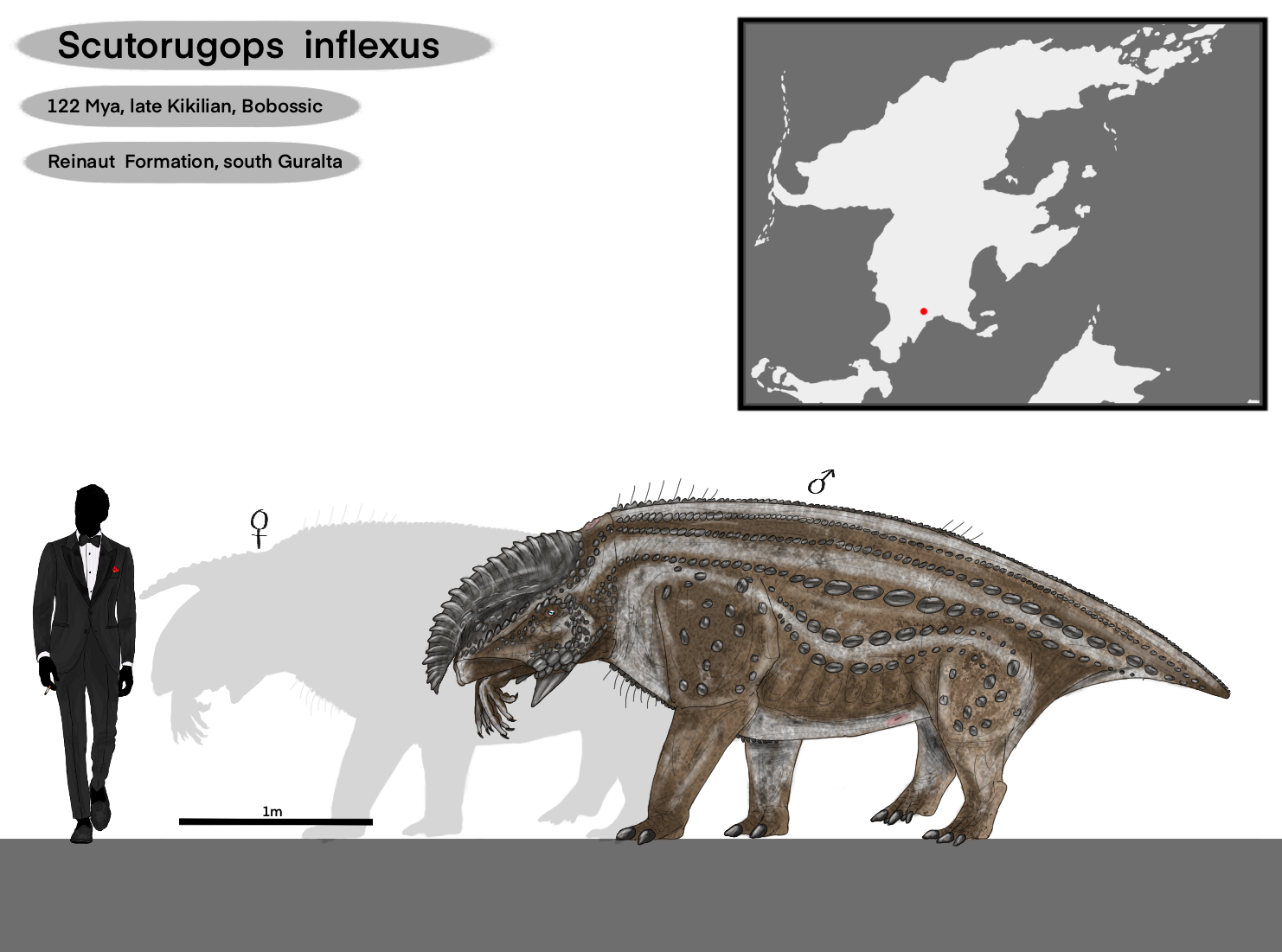
Reinaut Formation: Scutorugops


 The Reinaut Formation in the south of the continent called Guralta is one of, if not the most extensive fossil site from the late Bobossic. Dated to have been formed between 125 and 122 million Eryobian years ago, the Reinaut Formation offers a glimpse of what life was like in the Kikilian, the latest stage of the Bobossic right before the devastating mass extinction dubbed “The World Scarring” happened.
Back when it was formed, the Reinaut Formation was likely a subtropical or temperate open woodland subject to seasonal rains. The fossils discovered in the Reinaut Formation so far, have mostly been megafaunal animals which tended to fossilise better than smaller animals in the conditions that were present in Reinaut 122 million years ago.

Besides Pachystreptoceros and Addacoceros, a third a Ceratanodirid was present in the Reinaut Formation: the heavyset Scutorugops inflexus. Unlike the Streptoceratines, Scutorugops was part of a lineage that specialised in brawling and intraspecific combat. While the horns of Streptoceratines grew spiralling upwards, the horn of S. Inflexus did not spiral and instead grew forwards and curved down. The horn featured deep ridges reminiscent of the horns of an ibex.
Curiously, Scutorugops was the most numerous Ceratanodirid in Reinaut. A great number of both males and females have been discovered here, which likely indicates herd behaviour. Further support for this idea comes from the fact that S. Inflexus showed quite some sexual dimorphism, contradictory to most Streptoceratines. Males were on average much larger than females and had much larger horns that became fused to the osteoderms of the rostrum and, in some cases, even grew down below the mouth. It is unknown if this hindered their feeding, but the heavy wear on many of the males’ their horns showed that they frequently butted heads and those downturned horns might’ve protected their jaws and kept their teeth from shattering.
Being such a massive and social beast, an adult Scutorugops likely wouldn’t have had much to fear from predators and their herds likely would’ve made any bystander move out of their way.

Reinaut Formation: Addacoceros


 The Reinaut Formation in the south of the continent called Guralta is one of, if not the most extensive fossil site from the late Bobossic. Dated to have been formed between 125 and 122 million Eryobian years ago, the Reinaut Formation offers a glimpse of what life was like in the Kikilian, the latest stage of the Bobossic right before the devastating mass extinction dubbed “The World Scarring” happened.
Back when it was formed, the Reinaut Formation was likely a subtropical or temperate open woodland subject to seasonal rains. The fossils discovered in the Reinaut Formation so far, have mostly been megafaunal animals which tended to fossilise better than smaller animals in the conditions that were present in Reinaut 122 million years ago.

Besides Pachystreptoceros, the Reinaut Formation yielded a second Sterptoceratine Ceratanodirid dubbed Addacoceros formosus. Addacoceros was an average sized Ceratanodirid which, weighing up to about 3 metric tons, was still a massive animal. Typical of Streptoceratines, Addacoceros had one massive horn that curved around a central axis. This horn was most likely used predominantly for display, as it seemed to be quite fragile and not suited for intraspecific combat, though it may have been used to ward off predators. Addacoceros appears to have been a rare animal in its ecosystem. While the material assigned to Pachystreptoceros consists of the remains of about a dozen individuals, the amount of Addacoceros indivuals discovers can be counted on one hand. Whether it is purely a coincidence or an indicator of ecological niche, only one of those individuals appears to have been a male and unfortunately happened to also be the least complete. As such, there is no way of knowing to what extent Addacoceros displayed sexual dimorphism.

Reinaut Formation: Pachystreptoceros

The Reinaut Formation in the south of the continent called Guralta is one of, if not the most extensive fossil site from the late Bobossic. Dated to have been formed between 125 and 122 million Eryobian years ago, the Reinaut Formation offers a glimpse of what life was like in the Kikilian, the latest stage of the Bobossic right before the devastating mass extinction dubbed “The World Scarring” happened.
Back when it was formed, the Reinaut Formation was likely a subtropical or temperate open woodland subject to seasonal rains. The fossils discovered in the Reinaut Formation so far, have mostly been megafaunal animals which tended to fossilise better than smaller animals in the conditions that were present in Reinaut 122 million years ago.

By far the largest animal discovered in Reinaut was Pachystreptoceros giganticus. A huge Ceratanodirid, P. Giganticus is a contender for the title of largest terrestrial animal to have lived before the World Scarring. It had a huge spiralled horn that could measure over 1.5 meters long. Besides being huge, the skull of Pachystreptoceros suggests that, unlike other Streptoceratines, the horn of Pachystreptoceros was adapted for combat instead of being mostly for show. It would’ve been a formidable animal with practically no predators as adults.